



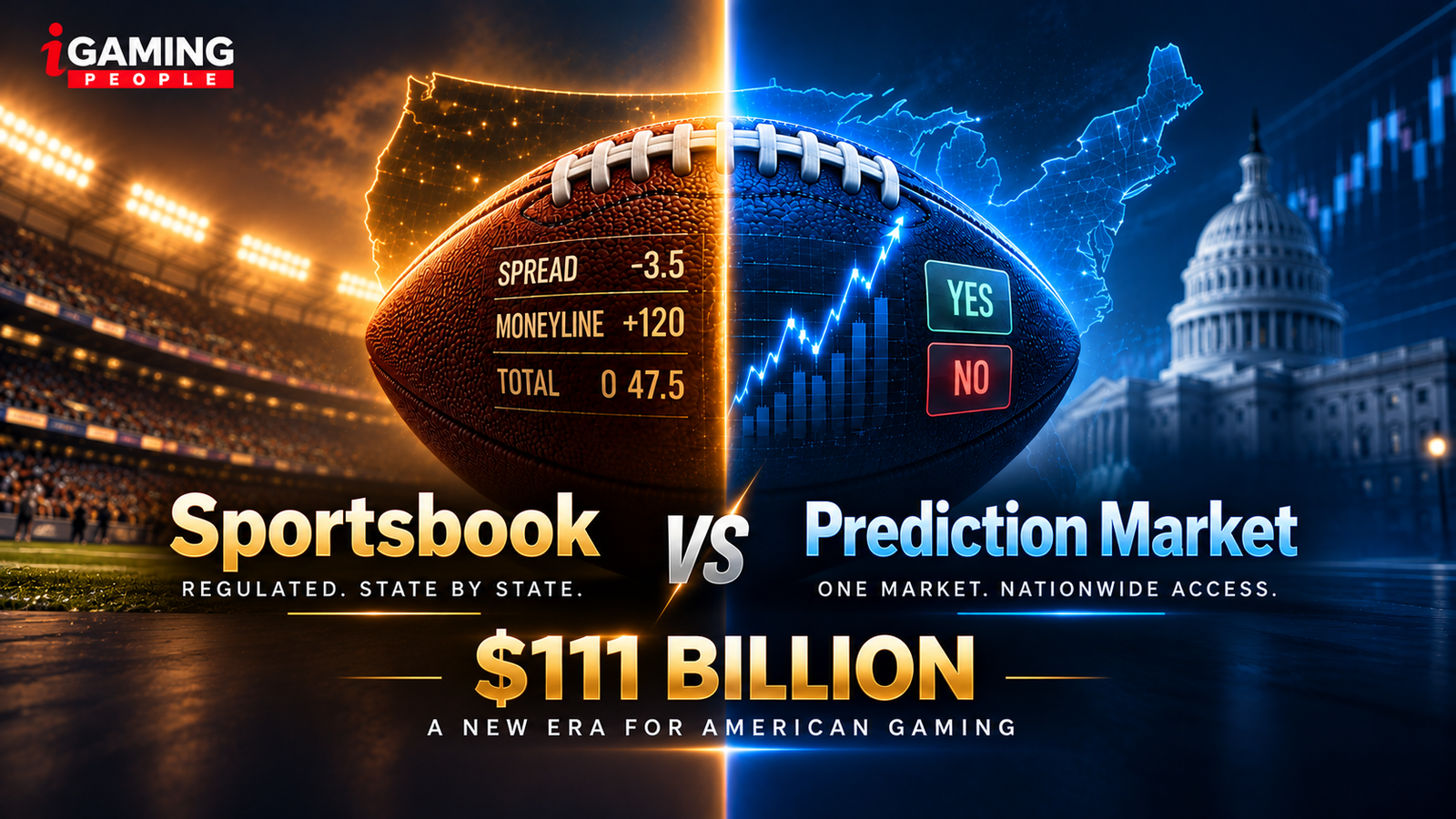
Two of the largest sportsbook operators on earth resigned from their own trade association in 2025. Weeks later, they launched the exact product that association was fighting in court. One of them has since lost its chief executive, halved its share price, and cut its full-year guidance by $395 million. The other is spending up to $300 million this year on a business line it openly expects to lose money.
This is not a story about a niche financial product. It is a story about the American gaming industry splitting in half over a single question — whether a contract on the outcome of a football match is a bet or a swap — and the answer changing depending on which federal appeals court you ask.
The Number That Should Worry Every Licensed Operator
Start with the figure the American Gaming Association put in front of Congress in July 2026.
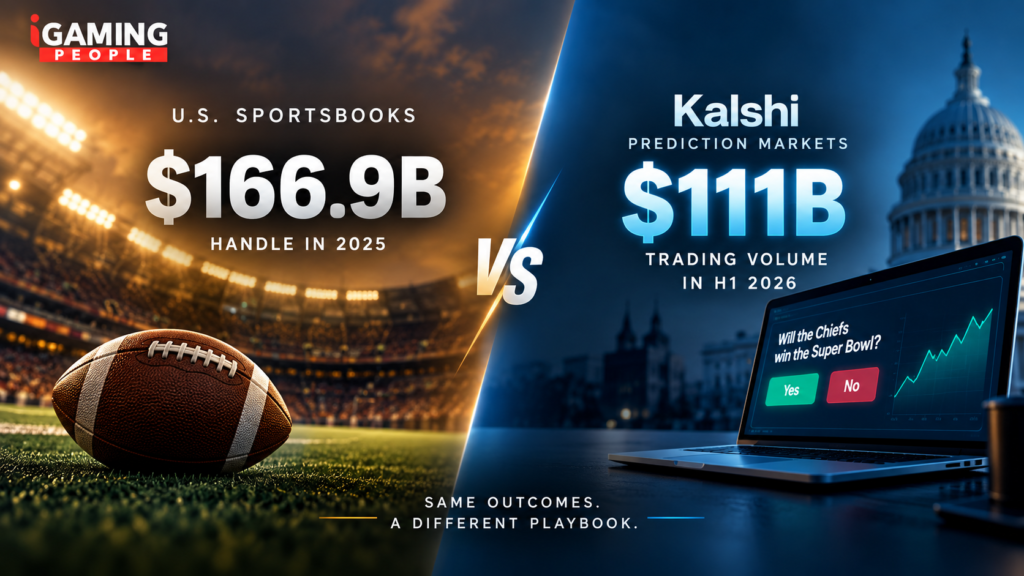
Kalshi traded $23.7 billion in notional volume across the whole of 2025. In the first six months of 2026 alone, it traded $111 billion.
More than 80% of that activity was sports.
For comparison, every licensed sportsbook in the United States combined took $166.94 billion in handle across the entirety of 2025 — a figure that itself represented a record year, up 11% on 2024. A single federally regulated exchange, operating without one state gaming licence anywhere in the country, is now moving numbers in the same league as the whole regulated industry it was supposed to be a curiosity alongside.
And it is not slowing. In June 2026, with the expanded 48-team World Cup running across North America, Kalshi’s notional volume topped $31 billion in a single month, up more than 70% from May. Polymarket’s international market hit a record of roughly $10.8 billion in the same period.
A year and a half ago, Kalshi did $226 million a month.
That is the entire story in two numbers. Everything else is detail.
Read Those Numbers Carefully — Most Coverage Is Not
Here is where this publication will part company with a lot of the reporting you have seen on this subject, because the headline comparison is not as clean as it looks and operators making board-level decisions deserve to know why.
There are two competing sets of volume data in circulation, and they do not agree.
Dune Analytics puts Kalshi’s June 2026 notional volume above $31 billion. DefiLlama puts it at $9.4 billion for the same month. Both figures were reported widely, often in the same week, frequently without acknowledgement that the other existed. The AGA’s congressional testimony — $111 billion across the first half of 2026 — is broadly consistent with the Dune notional series, which is why this article uses it.
There is a second, larger problem. Trading volume and sportsbook handle are not the same unit of measurement. A prediction market contract can change hands repeatedly before the underlying event settles. A sportsbook bet is placed once. Comparing $31 billion of notional trading against $14 billion of monthly handle overstates the gap, and anyone quoting the two side by side without saying so is selling a headline rather than an analysis.
The honest version is this: the direction, the growth rate, and the competitive threat are all real and all severe. The precise multiple is not knowable from public data.
That distinction matters commercially. If you are modelling cannibalisation for a board paper, the volume comparison will mislead you. The revenue comparison will not — and Kalshi’s annualised revenue reached roughly $4 billion by July 2026, driven overwhelmingly by sports, against total US commercial sports betting revenue of $16.96 billion for all of 2025.
What These Platforms Actually Are
Open the Kalshi app during an NFL Sunday and it looks like a sportsbook. You pick a side. You stake money on an outcome. If you are right, you get paid.
The difference is structural, not visual.
On a sportsbook, you bet against the house. The operator sets the price, takes the other side, and profits when you lose. On Kalshi or Polymarket, you buy a contract from another user at a price between one cent and ninety-nine cents, and the platform earns a fee regardless of who wins. It is the economics of an exchange, not a casino.
That structure is why the platforms are regulated by the Commodity Futures Trading Commission as designated contract markets, rather than by the state gaming commissions that license every sportsbook in America.
And that single regulatory fact is the whole commercial proposition: one federal registration replaces the state-by-state licensing patchwork that a traditional operator has to assemble jurisdiction by jurisdiction, at a fraction of the compliance cost we mapped in our [iGaming License Guide 2026](https://theigamingpeople.com/igaming-license-guide-2026-cost-comparison/).
It also delivers something no licensed sportsbook can buy at any price: legal distribution in California, Texas and Florida.
The Founders Who Sued the US Government and Won
Kalshi was founded in 2018 by Tarek Mansour and Luana Lopes Lara, who met as students at MIT. Mansour interned at Goldman Sachs and traded at Citadel Securities. Lopes Lara — a Brazilian who trained at an elite ballet academy affiliated with the Bolshoi before switching to computer science — worked at Bridgewater, Citadel and Five Rings Capital.
The company went through Y Combinator in 2019, received CFTC designation in 2020, and launched in July 2021.
Then it did something no gambling company would have done. When the CFTC blocked its election contracts, Kalshi sued the federal regulator it was asking for permission — a decision Lopes Lara has said some of the company’s own investors opposed. It won, listed political contracts ahead of the 2024 election, and in doing so established the legal ground on which the entire sports category now stands.
Sports contracts followed in January 2025. By December 2025 both founders were billionaires. Lopes Lara, at 29, is the youngest self-made woman billionaire in the world.
Polymarket took the opposite route and paid for it. Founded in 2020 by Shayne Coplan at the age of 22, it settled with the CFTC in January 2022 for $1.4 million over running an unregistered swap execution facility and agreed to block US users. The FBI raided Coplan’s home in late 2024. The investigation was dropped in July 2025, and within days Polymarket bought QCEX — a CFTC-licensed exchange and clearing house — for $112 million, buying its way back into the market it had been locked out of for three years.
Intercontinental Exchange, which owns the New York Stock Exchange, has since put $2 billion into it.
The Money Is Pricing These as Exchanges, Not Betting Apps
| Date | Kalshi | Polymarket |
| June 2025 | $2bn (Series D, $185m) | $1bn ($200m, Founders Fund) |
| October 2025 | ~$5bn | $9bn post-money (ICE commits up to $2bn at ~$8bn pre) |
| December 2025 | $11bn (Series E, $1bn, led by Paradigm) | — |
| April 2026 | — | $15bn (ICE completes $600m) |
| May 2026 | $22bn (Series F, $1bn, led by Coatue) | — |
| Q3 2026 (in talks) | ~$40bn (Sequoia and Wellington, $750m+) | Above $20bn |
Kalshi has raised roughly $2.7 billion across five rounds since June 2025. Its backers include Coatue, Sequoia, Andreessen Horowitz, Paradigm, Morgan Stanley and ARK Invest. Sequoia has stated Kalshi holds around 95% of the US prediction market by revenue.
Look at who is buying. Morgan Stanley. Wellington. The owner of the New York Stock Exchange. These are not gaming investors, and they are not applying gaming multiples. They are pricing market infrastructure — and ICE has been explicit that its interest is in distributing Polymarket’s probability data through the same pipes that carry NYSE equity pricing.
That is either the clearest signal yet that event contracts are a permanent asset class, or the largest regulatory-arbitrage position currently open in American finance. Nobody credible is claiming to know which.
The Defection: Three Sportsbooks Left the AGA, Then Built the Product It Was Fighting
This is the part that should hold every operator’s attention, and it is the part most coverage has underplayed.
In 2025, DraftKings, FanDuel and Fanatics all resigned from the American Gaming Association — the trade body leading the campaign against prediction markets. All three remain in the Sports Betting Alliance, which does not oppose federally regulated event contracts.
Then they launched.
- Fanatics Markets went live on 3 December 2025, first of the three.
- DraftKings Predictions launched on 19 December 2025 across 38 states and the District of Columbia, including sports event contracts in states where its own sportsbook is illegal — California, Florida, Georgia and Texas. It is now live in 48 states. Notably, DraftKings launched through CME Group, not through Railbird, the CFTC-licensed exchange it had bought in October 2025 for a reported $250 million.
- FanDuel Predicts launched on 22 December 2025 with CME Group in five states — Alabama, Alaska, South Carolina, North Dakota and South Dakota — under an arrangement where CME takes 50% of gross revenue and FanDuel carries all the costs.
Nevada’s response was immediate and brutal. The Gaming Control Board accepted the surrender of Flutter’s licences and withdrew DraftKings’ pending applications, stating flatly that both companies intended “to engage in unlawful activities related to sports event contracts.”
Two of the largest operators in global iGaming gave up their Nevada licences rather than abandon the product.
FanDuel’s framing is the strategically revealing one: it will withdraw sports event contracts from any state as that state legalises online sports betting. Prediction markets are not a replacement for the sportsbook. They are a bridge into states that have not opened yet.
DraftKings CEO Jason Robins was blunter about the marketing advantage, telling investors the company can promote both products with the same message because “most customers don’t really even understand the difference.”
For a licensed industry that has spent seven years arguing regulation is what separates it from the grey market, that sentence should land hard.
What It Is Costing Them
The financial picture is not the triumphant one the launch announcements implied.
DraftKings is investing an incremental $200–300 million into predictions in 2026, funded out of roughly $1 billion of core sportsbook EBITDA. Susquehanna estimated total spend nearer $400 million once customer acquisition is included; Bank of America has modelled losses as high as $550 million. DraftKings shares fell 18% on the February guidance, hitting their lowest level since May 2023.
Flutter has fared worse. FanDuel’s parent guided to as much as $300 million of adjusted EBITDA losses on prediction markets in 2026. Then came the second quarter: a net loss of $296 million against $37 million of net income a year earlier, adjusted EBITDA down 45%, US sportsbook revenue down 15% year on year during a World Cup, and full-year guidance cut by $395 million of revenue and $210 million of EBITDA.
On the same day, Flutter announced that Peter Jackson would step down as group chief executive after nine years, succeeded by Dan Taylor on 1 October. FanDuel CEO Amy Howe had already stepped aside in May. Flutter shares are down roughly 50% across 2026.
Collectively, the major US operators are projecting more than $500 million in combined lost adjusted EBITDA in 2026 from prediction markets alone. PENN Entertainment CEO Jay Snowden has warned of an approaching “very aggressive, irrational” spending war heading into football season.
The one line that is actually working is the least glamorous. Both DraftKings and FanDuel have moved into market-making on exchanges — Flutter expects roughly $50 million of market-making revenue this year, and Citizens analyst Jordan Bender models gross margins approaching 95% and $243 million of DraftKings market-making revenue by 2027.
If you supply this industry, note that carefully. Market-making is a genuinely new B2B revenue layer sitting adjacent to traditional odds compilation and risk management, and firms including Susquehanna and Jump Trading are already established in it. Robinhood and Susquehanna’s joint venture, Rothera, took 7% of the US market in its debut month.
The Legal Fight: Two Appeals Courts, Two Opposite Answers
There is no single national answer to whether any of this is legal. There are two, and they contradict each other.
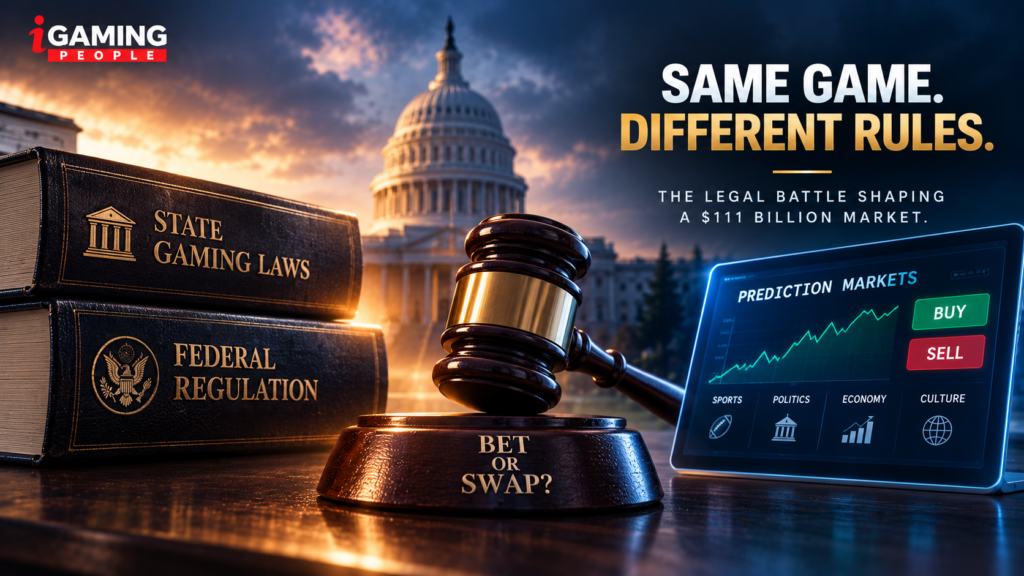
Third Circuit, 6 April 2026. In the first federal appellate ruling on the question, the court held 2-1 that Kalshi’s sports event contracts are swaps under the Commodity Exchange Act, falling within the CFTC’s exclusive jurisdiction and pre-empting New Jersey’s gambling laws. A clean win for the platforms.
Ninth Circuit, 28 August 2026. A unanimous panel of three Trump-appointed judges reached the opposite conclusion, siding with Nevada regulators and Las Vegas casinos. “Kalshi has a gambling problem,” the court wrote, adding that the substance of the contracts “is sports gambling, regardless of whether Kalshi calls them swaps,” and that the CFTC “is not a national gambling regulator.” Kalshi is seeking further review.
That is a textbook circuit split, and it is binding precedent across nine states including California and Arizona. New Jersey has said it intends to take its case to the Supreme Court.
Around that central conflict:
- The CFTC has sued nine states — Arizona, Connecticut, Illinois, New York, Wisconsin, New Mexico, Minnesota, Rhode Island and Kentucky — arguing state gambling statutes are unconstitutional as applied to event contracts. Chairman Michael Selig, who is currently the sole member of what is meant to be a five-member commission, has been unusually direct: “If you interfere with the operation of federal law in regulating financial markets, we will sue you.”
- Minnesota became the first state to criminalise prediction markets outright when Governor Tim Walz signed SF4760 on 18 May 2026, making operation or advertising a felony. The CFTC sued within 24 hours. On 27 July, days before the law was due to take effect, a federal judge blocked it. It remains blocked.
- Illinois wrote prediction markets into its FY2027 budget, imposing a licensing requirement and the country’s first state tax aimed specifically at event contracts — tiered at 1.75% on the first five million contracts traded annually and 3.5% above that, with a 15% levy on gross receipts routed to a state Sports Wagering Fund. Kalshi and the CFTC both sued.
- Arizona filed criminal charges against Kalshi executives. A federal court paused the prosecution.
- Roughly 20 states are in active litigation. Litigation has now reached nine federal appeals courts.
In Congress, the Prediction Markets Are Gambling Act — Schiff and Curtis in the Senate, Horsford and Amodei in the House, all bipartisan — would bar CFTC-registered entities from listing any contract resembling a sports bet or casino game. Competing bills from Gillibrand and McCormick would instead build a permanent federal framework. With midterms in November, a floor vote before the next Congress looks unlikely.
The honest summary: sports event contracts are lawful in some states, contested in most, and criminal in none right now — and which category your state occupies can change inside a news cycle.
The Casino Industry’s Number, and the Lobbying War Behind It
The AGA has made the fiscal argument central. Its live tracker crossed $1 billion in lost state and tribal gaming tax revenue in May 2026. By the July congressional hearing, AGA and the Indian Gaming Association put the joint figure at more than $1.2 billion.
For context, US commercial gaming generated a record $78.7 billion of gross gaming revenue in 2025 and $17.9 billion in gaming taxes. Prediction markets pay none of it.
The AGA’s framing, delivered by SVP Chris Cylke to the House Agriculture subcommittee, is that these are “backdoor sportsbooks” offering functionally identical products — moneylines, totals, parlays, player props — without licensing fees, gaming taxes, advertising restrictions, or the age verification, geofencing and self-exclusion obligations licensed operators carry by law.
The lobbying numbers tell you how seriously both sides are taking it, and they do not run the way most people assume.
Kalshi spent $990,000 on direct federal lobbying in the first half of 2026 — nearly its entire 2025 total — and close to $1.8 million including outside firms, its highest six-month figure on record. It retains seven lobbying firms and counts Donald Trump Jr. as a paid adviser. Its founders have given roughly $1 million combined to candidates of both parties. Polymarket’s parent, Blockratize, donated $1 million to a House Republican super PAC.
The AGA has committed $1.39 million, up 30% year on year. Casinos and the AGA together have spent at least $3.3 million. But by CNN’s count, the prediction market companies have outspent them — at least $5.6 million this year.
The new entrant is now outbidding the incumbent in Washington. One industry source described the fight to CNN in three words: “an all-out war.”
The Evidence of Cannibalisation Has Arrived
For most of 2026, DraftKings and Flutter told investors they saw no meaningful cannibalisation of sportsbook handle.
The AGA’s own data now suggests otherwise. From September 2025 through May 2026 — the first full football season in which prediction markets offered a broad sports menu — US sportsbook handle grew by 4%. Over the same window a year earlier, it grew 14%.
Growth did not stop. It slowed by roughly two thirds.
The preseason signal for 2026 is starker still. Kalshi took $162,934 of volume on a Week 3 NFL preseason game in 2025. The equivalent fixture in 2026 took more than $5.8 million. Eilers & Krejcik measured August NFL prediction market volume at 4.6 times the prior year. Kalshi had already booked $621 million in preseason volume by 5 September.
Forecasts for the full 2026–27 NFL season range from $36.8 billion (RotoWire) to $57 billion (DeFi Rate’s central case), against $7.21 billion last season.
The season that starts this month is the real test. It is the first in which Kalshi, Polymarket, DraftKings Predictions, FanDuel Predicts, Fanatics, Robinhood, Underdog and Novig all compete across a full NFL calendar.
Why This Matters If You Are Not a US Operator
Three reasons this is not a domestic American story.
The regulatory template is being drafted in real time, and templates travel. Every serious regulator is watching how the United States answers “is this a financial product or is it gambling,” because the exchange-versus-house question is not geographically bound. The sweepstakes casino playbook followed exactly this shape — a legal reclassification that scaled to billions before regulators caught up.
Your competitors’ capital is being reallocated, and it is coming out of markets you operate in. Flutter cut group guidance by $395 million. That reduction is absorbed across a portfolio spanning the UK, Ireland, Italy, Brazil, India and Africa. If you supply, partner with or compete against a Flutter-owned brand anywhere on earth, this fight is already in your P&L.
The valuation logic resets what a gambling company is worth. As we set out in The Hidden Economics of iGaming, operator margins are squeezed from every direction before tax. An exchange with no house edge, one federal registration and near-95% market-making margins is being priced by the investors who price stock exchanges — at multiples no licensed operator commands. That logic does not stay inside one border once capital notices it.
What Each Part of the Industry Should Be Watching
Operators. The strategic question is no longer whether to enter, but whether a mid-tier operator can compete against $300 million category budgets. On current evidence, this is consolidating into the same duopoly that already owns US sports betting. BetMGM and Caesars both said at G2E they would not pursue sports event contracts; BetMGM has since scoped a product and Caesars has held preliminary CFTC discussions. Watch whether that resolve holds through a full NFL season.
Suppliers and platform providers. Market-making is the opportunity, not the retail app. It is a new layer in the supply chain with exchange-grade margins, and — as we argued in The iGaming Supplier Graveyard — new layers are where suppliers who move early actually reach scale.
Investors and corporate development. Bernstein’s view is that consolidation, not IPOs, is the likelier endgame. DraftKings, Robinhood and Coinbase have each bought or built exchange infrastructure in the past year. Kalshi has said an IPO would not come before 2027, and unresolved state litigation sits on the balance sheet in the meantime.
Compliance and legal. There is no national answer to give a board. The Third and Ninth Circuits disagree, nine CFTC suits are live, and roughly twenty states are litigating. A state-by-state map, refreshed monthly, is currently the only defensible way to advise anyone.
The Bottom Line
The regulated gaming industry spent seven years after the repeal of the federal sports betting ban building something genuinely impressive: 38 jurisdictions, $78.7 billion of revenue, $17.9 billion in tax, and a consumer protection regime that mostly works.
It built all of it on the assumption that gambling is regulated by states.
A company founded by two MIT graduates, which sued the federal government to be allowed to list election contracts, has spent eighteen months demonstrating that the assumption was a choice rather than a law of nature. Three of the biggest sportsbooks in America agreed with it strongly enough to quit their own trade body and build competing products. One of them has since lost its chief executive and half its market value doing so.
What remains unresolved is narrow and enormous at the same time: whether a contract on a football match is a swap or a bet. The Third Circuit says swap. The Ninth Circuit says bet. Until the Supreme Court says otherwise, both answers are law, in different parts of the same country.
The industry’s instinct has been to treat this as a legal problem that will eventually be settled by lawyers.
It is not. It is a distribution problem, and it has already been settled by the market. Prediction markets reached all fifty states before the courts finished arguing about whether they were allowed to, and the operators who understood that early are the ones now defending market share rather than trying to win it back.
The licensed industry has seen this film before, with sweepstakes casinos, with offshore books, with skill machines. Each time, the gap between what consumers wanted and what the law had gotten around to addressing generated its own economy. Each time, that economy was already too big to dislodge by the time enforcement arrived.
The only question left is whether prediction markets end up folded into state gaming regulation — or whether state gaming regulation ends up as the expensive option nobody chooses.
Both are still live. Position accordingly.
The iGaming People covers the global iGaming industry with a focus on data, insight, and the people behind the business. Follow us on LinkedIn for daily updates.
Figures current as at 7 September 2026. Given the pace of litigation and fundraising in this sector, verify current valuations and state legal status before citing specific numbers.
Related Reading
- The $10 Billion Ghost — How Sweepstakes Casinos Built America’s Largest Unregulated Gambling Industry
- You Paid for the Licence. They Didn’t. Here Is Why They Are Winning.
- iGaming License Guide 2026 — From €7,000 to €800,000
- The Hidden Economics of iGaming — Who Really Makes the Most Money?
- The iGaming Supplier Graveyard — Why Most Vendors Never Reach Scale
Sources
- Kalshi $23.7bn 2025 volume, $111bn H1 2026, 80%+ sports — AGA/IGA testimony, House Agriculture Subcommittee, 21 July 2026 (Yogonet, CDC Gaming)
- Kalshi June 2026 notional volume $31bn, +70% on May; Polymarket International record $10.8bn — Dune Analytics via CNBC, BigGo Finance
- Competing DefiLlama series ($9.4bn Kalshi June, $4.3bn Polymarket) — Cointelegraph, TradingView, KuCoin
- Kalshi $226m monthly volume December 2024; annualised revenue ~$4bn July 2026; ~95% US market share — The Information via CoinDesk, Sequoia Capital
- US commercial gaming $78.7bn GGR, $17.9bn gaming tax, sports betting $16.96bn revenue on $166.94bn handle 2025 — AGA State of the States 2026 and Commercial Gaming Revenue Tracker
- Kalshi funding rounds and valuations — CoinDesk, Financial Times, Cryptopolitan, Investing.com
- Polymarket valuations, ICE $2bn commitment and $600m completion — ICE investor relations releases (Oct 2025, 27 March 2026); Bloomberg via TechFundingNews
- Polymarket QCEX acquisition $112m, 2022 CFTC settlement, September 2025 no-action letter — PR Newswire, CoinDesk
- Kalshi founder backgrounds and election-contract litigation — CNBC Changemakers, Forbes, Kalshi company materials
- DraftKings, FanDuel and Fanatics AGA resignations — Sportico, April 2026
- Fanatics Markets (3 Dec 2025), DraftKings Predictions (19 Dec 2025, 38 states + DC), FanDuel Predicts (22 Dec 2025, five states, CME 50% revenue share) — company releases, Reuters, iGaming Business, CDC Gaming
- Nevada Gaming Control Board statement on Flutter and DraftKings licences — Sportico, November 2025
- Robins quote on customer understanding — InGame, February 2026
- DraftKings $200–300m investment, Susquehanna $400m and BofA $550m estimates — InGame, iGaming Business, Bloomberg
- Flutter Q2 2026 net loss $296m, EBITDA -45%, guidance cut $395m/$210m, CEO transition — Flutter Q2 2026 results and 8-K, 5 August 2026
- Combined $500m+ projected EBITDA losses; PENN “irrational” spending warning — BettorsInsider, August 2026
- Market-making economics, Citizens $243m 2027 model, Flutter ~$50m 2026 — iGaming Business, July 2026
- Third Circuit ruling, 6 April 2026 (2-1) — Forbes; PYMNTS
- Ninth Circuit ruling, 28 August 2026 (3-0) — CNN Business, The Hill, PYMNTS, Reason
- CFTC suits against nine states; Selig statements — CFTC press releases 9206-26, 9220-26, 9230-26; ESPN; The Hill; RotoWire legal timeline
- Minnesota SF4760 signed 18 May 2026, blocked 27 July 2026 — NPR, MinnPost, Courthouse News
- Illinois SB 3019 tax and licensing regime — Courthouse News, PlayUSA, Capitol News Illinois
- Prediction Markets Are Gambling Act and competing bills — Senate offices of Schiff, Curtis, Gillibrand, McCormick; Rep. Horsford; Venable LLP legislative tracker
- AGA/IGA $1.2bn lost tax estimate; “backdoor sportsbooks” — CDC Gaming, CNBC, BettorsInsider
- Lobbying disclosures: Kalshi $990k direct/$1.8m total H1 2026, AGA $1.39m, casinos $3.3m, prediction markets $5.6m — CNBC, NOTUS, CNN Business
- US sportsbook handle growth 4% vs 14% prior year — AGA data via ESPN, September 2026
- NFL preseason volume comparisons, Eilers & Krejcik 4.6x, season forecasts — Covers, DeFi Rate, ESPN/RotoWire
- Robinhood Q2 2026 event contracts: 13.6bn contracts, $156m revenue — DeFi Rate
- Bernstein consolidation thesis — Benzinga, August 2026