




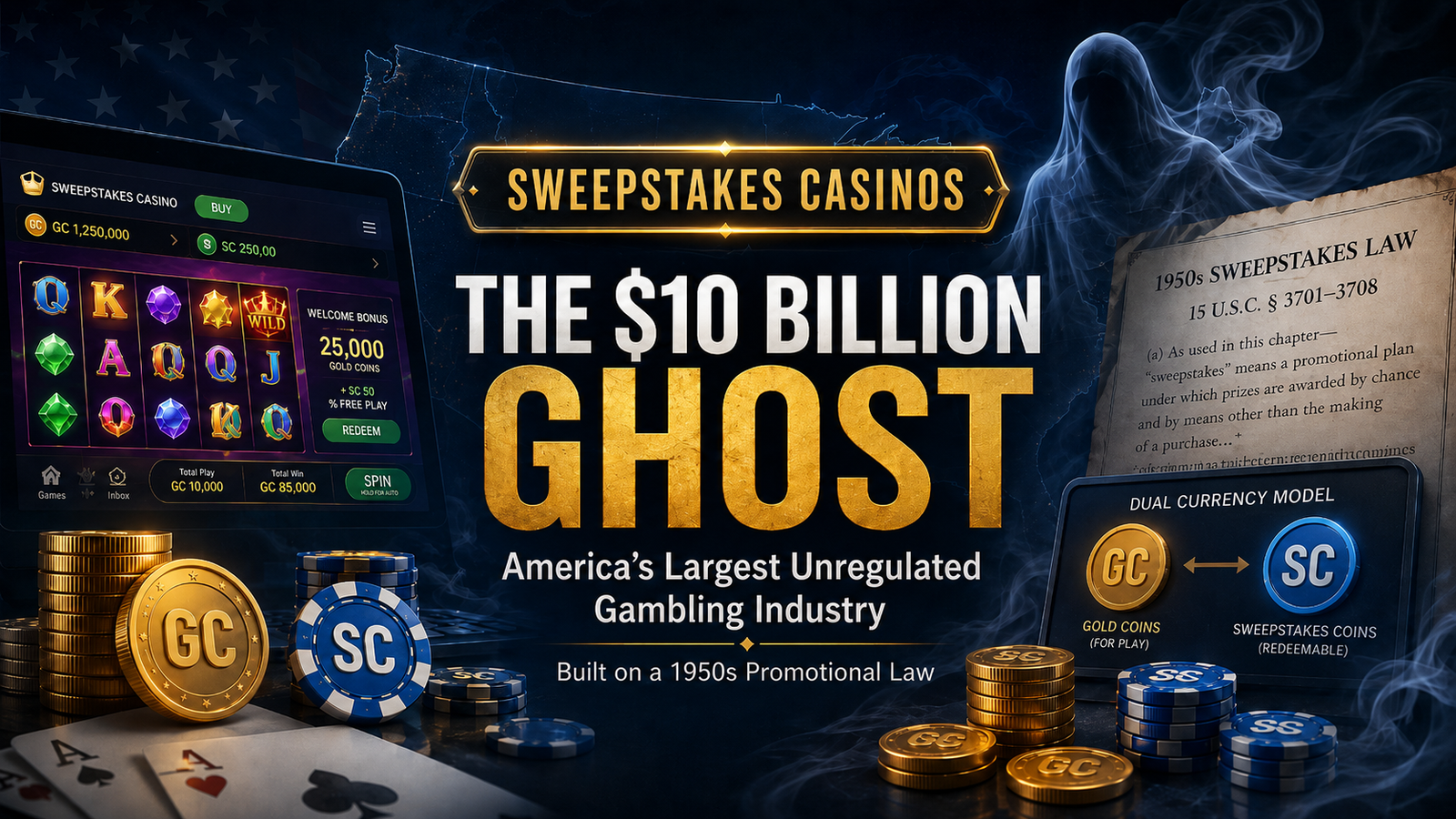
There is a company based in Perth, Australia that generated $5.2 billion in revenue last year from American players. It does not hold a single US gambling license. It does not pay gambling taxes in the states where it operates. It has never been approved by the American Gaming Association. And it is entirely legal — built on a legal principle that was designed to protect the winners of breakfast cereal promotions.
This is the story of the sweepstakes casino — the most audacious regulatory arbitrage in the history of iGaming. And it is a story the industry is only beginning to fully reckon with.
The Number That Changes Everything
Let us start with a comparison that puts everything in context.
In 2024, regulated iGaming — online casino gaming in the seven US states where it is actually legal — generated $8.41 billion in gross gaming revenue. This is the result of billions of dollars in licensing fees, years of regulatory negotiations, compliance infrastructure, responsible gambling programmes, and tax payments to state governments.
In the same year, the sweepstakes casino industry — operating without a single gambling license in any of those states — generated an estimated $10.6 billion in gross revenue, rising to between $11 and $14.3 billion in 2025 depending on measurement methodology.
The unregulated market is larger than the regulated one. And growing faster.
This is not a grey market operating in shadows. These are websites with professional game studios, celebrity endorsements, F1 sponsorships, and tens of millions of registered players who believe — because they are told — that they are not gambling.
The Legal Architecture of the Loophole
To understand how this is possible, you need to understand a century-old principle of American promotional law.
Under US law, an activity is legally classified as gambling only when three elements are present simultaneously:
- Consideration — you pay to participate
- Chance — the outcome is random
- Prize — you can win something of value
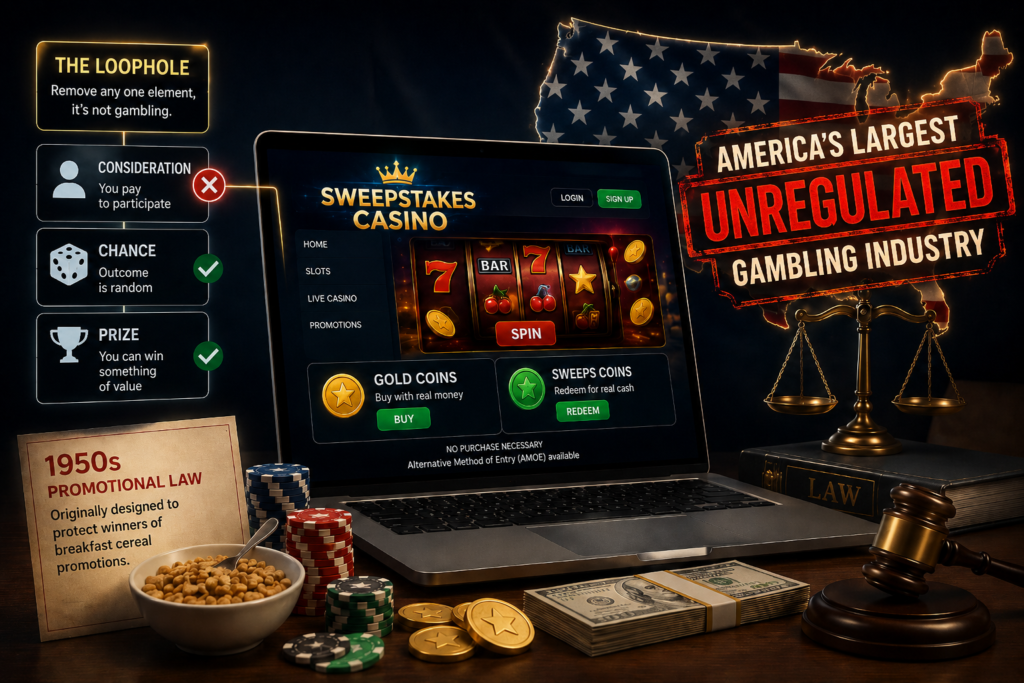
Remove any single leg from this three-legged stool, and the activity is no longer legally gambling. This is the principle behind every “no purchase necessary to enter” sweepstakes — from McDonald’s Monopoly to supermarket loyalty point draws.
Sweepstakes casinos took this principle and scaled it into a multi-billion-dollar industry.
Here is how the model works:
Currency 1 — Gold Coins. These are a virtual currency you can purchase with real money. You buy packages — $9.99 for 200,000 Gold Coins. Gold Coins can be used to play casino games. Gold Coins have zero cash value and cannot be redeemed for prizes.
Currency 2 — Sweeps Coins. Sweeps Coins can be redeemed for real cash prizes — typically at a rate of 1 Sweeps Coin = $1. But here is the critical claim: Sweeps Coins can never be purchased directly. When you buy a Gold Coin package, you receive Sweeps Coins as a “free bonus.” You can also claim Sweeps Coins through daily login rewards, social media promotions, or — the legal cornerstone of the entire model — by mailing in a physical written request to receive them for free.
That last option — the mail-in Alternative Method of Entry (AMOE) — is the thing that makes the whole legal structure stand up. Because it means players technically never paid for the chance to win. The consideration leg of the stool is removed. Therefore, legally speaking, it is not gambling. It is a promotional sweepstakes.
On the same slot machine games. With the same visual design as a real casino. With the same random number generators. With the same win/loss mechanics. With cash prizes that can be withdrawn via bank transfer.
Kentucky Attorney General Russell Coleman summarised the industry’s legal position with memorable clarity: “You can call bourbon an adult beverage distilled from corn, but it’s still bourbon. You can change the nomenclature, but at the end of the day, if you look at the nature of what these are — this is gambling.”
VGW: The $7.3 Billion Company That Built an Empire From a Loophole
The company most responsible for building the sweepstakes casino industry into what it is today is Virtual Gaming Worlds (VGW) — a Perth, Australia-based company founded by Laurence Escalante that most people in the mainstream iGaming industry had never heard of until recently.
The growth trajectory is extraordinary:
| Year | VGW Revenue |
| 2020 | $770 million |
| 2022 | $3.4 billion |
| 2024 | $6.13 billion |
| 2025 | $7.3 billion (A$7.3B) |
That is 575% revenue growth in five years. Chumba Casino alone — one of VGW’s brands — generated $3.7 billion in the fiscal year ending June 2025. VGW’s profits in the same period surged 33.5% to $656 million, with nearly $1 billion in liquid assets.
The company brought in celebrities to promote Chumba Casino — Olympic swimmer Michael Phelps, TV host Ryan Seacrest. It sponsored the Ferrari Formula 1 team. It controlled 90% of the US sweepstakes casino market at one point.
Then things got complicated.
The Crackdown: 100+ Lawsuits, 16 State Bans, and a CEO Arrested
The regulatory response to sweepstakes casinos accelerated dramatically in 2025–2026.
The State-by-State Dismantling
California passed Assembly Bill 831 on October 11, 2025. The vote: 63-0 in the Assembly, 36-0 in the Senate. Not a single legislator voted against it. The law took effect January 1, 2026. California’s ban wiped out an estimated $1.68 billion in annual sweepstakes casino revenue overnight.
New York followed. Montana passed legislation making violations punishable by up to 10 years in prison and $50,000 in fines. Connecticut made sweepstakes casino operations a criminal violation. In 2026 alone, Indiana, Maine, Tennessee, Oklahoma, and Louisiana passed prohibition bills.
By mid-2026, VGW faces restrictions or outright bans in 16 US states — up from just 4 in 2024.
The Lawsuit Explosion
More than 100 class action lawsuits were filed against sweepstakes operators in 2025 alone. Louisiana filed suit seeking $44 million in unpaid taxes from VGW and WOW Vegas. Kentucky filed lawsuits against VGW, Chumba Casino, Global Poker, and LuckyLand Slots. Mississippi sent cease-and-desist letters to 10 operators. Louisiana’s Gaming Control Board issued orders to 42 operators.
The CEO Situation
VGW founder Laurence Escalante — the man who built a $7 billion gaming empire on a breakfast cereal promotion law — was arrested by Australian authorities in 2025 on multiple charges. He subsequently took the company private at an A$3.2 billion valuation and stepped back from the CEO role.
The Numbers That Regulated Operators Cannot Ignore
For licensed iGaming operators — the ones who spent years and millions obtaining proper licenses, building compliance infrastructure, and paying state taxes — the sweepstakes casino explosion is not an abstract policy debate. It is a direct attack on their business model.
In April 2026, regulated iGaming in the US generated $1.00 billion in a single month — a 15% increase year-on-year. Impressive growth. But the American Gaming Association notes explicitly that this figure is significantly lower than it should be, because of revenue diverted to sweepstakes casinos and prediction market platforms — none of which pay state gaming taxes.
The Tax Gap
Regulated gaming generated $1.59 billion in state tax revenue in April 2026 alone. Sweepstakes casinos — which generated comparable or larger consumer spending — contributed zero dollars in gambling tax revenue to any state.
VGW itself offered to pay California sales tax on Gold Coin purchases — estimated at $149 million annually — if the state would allow them to continue operating rather than imposing an outright ban. California banned them anyway.
90% of Players Think They Are Gambling. The Law Says They Are Not.
Here is the most uncomfortable data point in this entire story.
A survey found that 90% of sweepstakes casino players describe what they are doing as “gambling.” They experience it as gambling. They think of it as gambling. They feel the same emotional responses as gamblers.
But they have none of the protections of regulated gambling:
No mandatory responsible gambling tools. No requirement for third-party RNG certification. No deposit limits enforced by regulation. No formal self-exclusion database. No independent dispute resolution process. No regulatory oversight of game odds.
The average sweepstakes casino player is gambling — psychologically, emotionally, and financially — with none of the consumer protections that regulated casinos are legally required to provide.
Approximately 71% of sweepstakes casino players are between 21 and 34 — a younger demographic, less financially resilient, and more susceptible to the social media-driven marketing that sweepstakes casinos use extensively.
The Bottom Line
A company built a $7 billion gambling business on a loophole in a 1950s promotional law. Ninety percent of its users think they are gambling. They have fewer protections than if they walked into a licensed casino. The company pays no gambling taxes. And for five years, regulators did not have the tools — or the will — to stop it.
Now they are trying to. But the industry generated $10+ billion last year, has 38 million active users, and employs thousands of people. It will not disappear quietly.
The sweepstakes casino story is not really about loopholes. It is about the gap between what consumers want, what laws allow, and what regulators are capable of responding to in real time. That gap, when left open long enough, generates its own economy.
In the US in 2026, that economy is worth more than the regulated iGaming market it has been quietly competing against.
That fact alone should concern every licensed operator, regulator, and investor reading this.
Related Reading: