




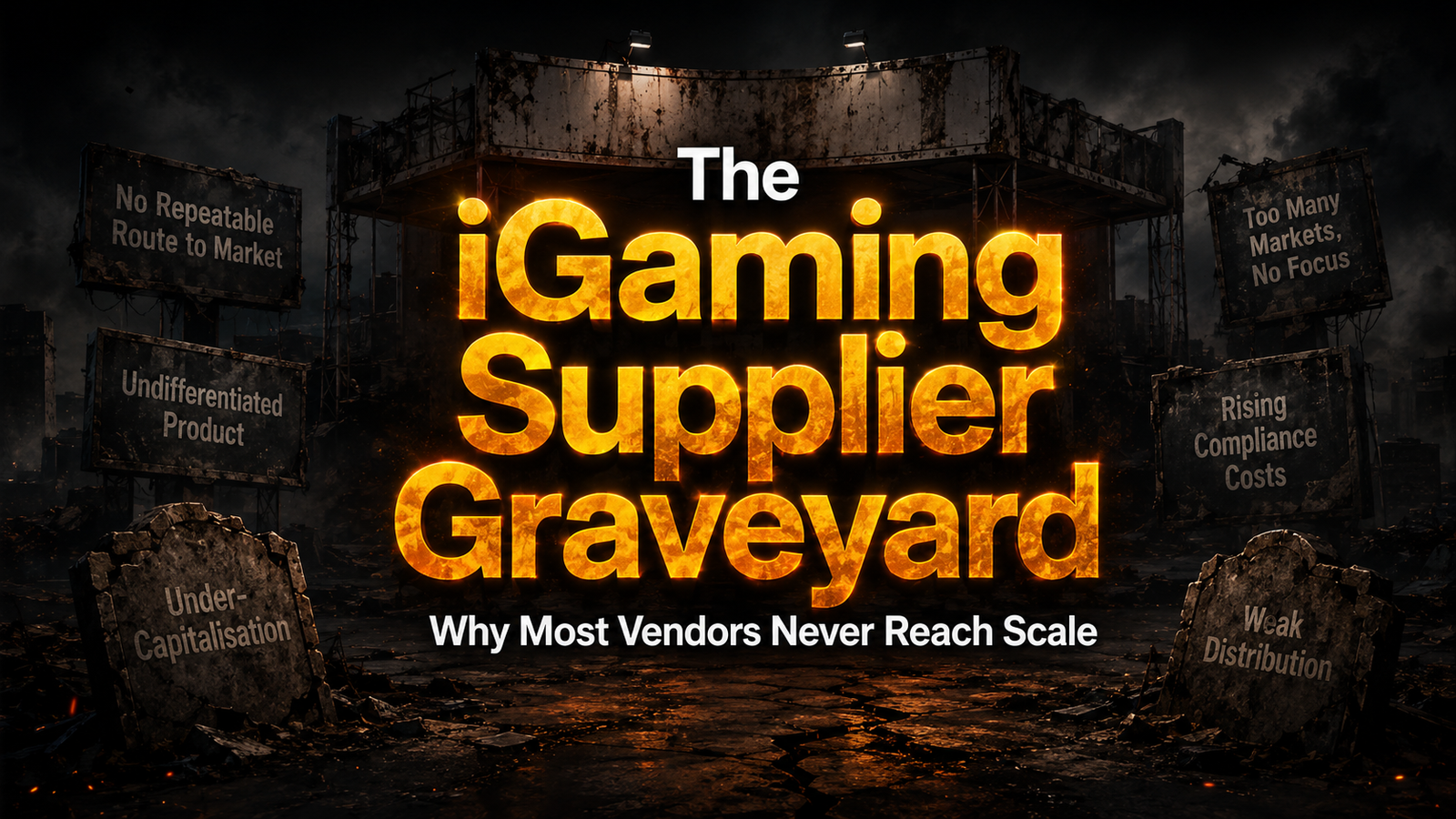
They had a booth at ICE, a deck full of promises, and revolutionary technology. Three years later, nobody remembers the name.
This is not a comfortable article. It is a sourced one. If you are building an iGaming supplier business — or funding one — the numbers in here are the ones your board should be looking at.
Key takeaways
- The market is more crowded than most founders realise. A single aggregator — SOFTSWISS — now distributes more than 40,000 titles from over 300 providers. Two years ago that same platform carried under 28,000 games. Supply is growing far faster than the number of operators able to buy it.
- 2026 changed supplier economics, not just operator economics. UK Remote Gaming Duty doubled from 21% to 40% on 1 April 2026. When a licensee’s casino margin compresses that hard, supplier rev-share is one of the first three levers pulled.
- Most suppliers don’t die. They get absorbed, or they become zombies — solvent, sub-scale, permanently invisible. That is the modal outcome, and almost nobody plans for it.
- Category ownership wins the land grab. It does not confer immunity. Evolution, the industry’s best example of focus, reported falling revenue in the first half of 2026 and settled a UK licence review for £4.75m.
- Distribution beats technology, consistently. Average technology with excellent distribution outperforms exceptional technology with none — and the fastest route to distribution is rarely direct sales.
The scene is familiar
January. Barcelona. Fira Gran Via.
ICE Barcelona 2026 drew 51,996 visitors, part of a 62,988-strong World Gaming Week audience from 162 countries, across 794 exhibiting companies. Those are the audited numbers. In the weeks before the show, the widely reported projections were 65,000-plus delegates and more than 1,000 exhibitors.
Hold that gap in mind. It is the whole industry in miniature: the number in the deck, and the number in the audit.
Walk the floor and you see them everywhere. The new ones. Fresh branding. Confident pitch. A product described as AI-powered, agentic, next-generation, or — the classic — the last platform you will ever need.
Most will not be exhibiting at ICE Barcelona in January 2027.
Some will return with a smaller booth and a new tagline. Most will simply be gone, or quietly folded into somebody else’s cap table, or still technically trading with four clients and no growth. The industry produces new suppliers considerably faster than it produces new operators to buy from them.
This is not bad luck. It is a pattern with causes that are largely predictable — and, in 2026, causes that have materially changed.
First, define the graveyard: what “failure” actually looks like
The word failure implies a funeral. In practice, supplier outcomes fall into five states, and confusing them is why most industry conversation about supplier mortality is useless.
| Outcome | What it looks like | Roughly how it ends |
| Category owner | Defines a product category, becomes default in it, prices accordingly | Independence, IPO, or a premium trade sale |
| Absorbed | Sound product, sub-scale distribution, acquired for tech, licences or team | Trade sale — frequently the good outcome |
| Zombie | Solvent, four to eight clients, flat revenue, no roadmap budget, still exhibits | Indefinite. This is the most common outcome |
| Dead | Runs out of cash mid-sales-cycle | Quiet dissolution, no announcement |
| Pivoted out | Leaves iGaming for adjacent verticals where the barriers are lower | Survives as a different company |
Two observations matter here.
First, absorption is not failure. Selling a supplier business for a sensible multiple after five years is a rational, common and often excellent outcome. Founders who plan for category ownership and refuse absorption on principle frequently end up in the zombie column instead.
Second, there is no reliable industry-wide failure-rate data, and anyone quoting one — including the “80% fail” figures that circulate freely at conferences — is estimating. That absence is itself informative. It means the honest question is not what percentage die, but what separates the five outcomes. That is what the rest of this article is about.
Why there are too many of everything
The supplier market is, by any honest measure, oversupplied. Three forces combine to keep it that way.
Barriers to entry have collapsed. Cloud infrastructure, mature open-source frameworks, remote engineering talent across Malta, Estonia, Ukraine, Georgia and increasingly Latin America, and a well-documented integration playbook have compressed the cost of a demo-ready iGaming product to a level that would have been implausible a decade ago. Demo-ready is not the same as certified, integrated and revenue-generating — but it is enough to fund a booth.
Content supply is growing faster than demand. SOFTSWISS’s Game Aggregator crossed 27,800 titles from 280-plus providers in early 2025, passed 35,000 in August 2025, and now lists more than 40,000 games from over 300 providers, certified across roughly 24 jurisdictions. That is a single aggregator. The number of operators capable of meaningfully merchandising that volume has not grown remotely in proportion. For a new studio, the practical consequence is brutal: getting into the catalogue is no longer distribution. It is a queue.
The headline market number flatters everyone. Global online gambling revenue estimates cluster somewhere between $88bn and $101bn for 2025–26, depending on methodology, and H2 Gambling Capital projects total global gambling GGR crossing $1trn by 2030. Those are real numbers. They are also almost irrelevant to a new supplier, because the addressable slice — operators large enough to pay, small enough to be reachable, and in a jurisdiction where you are certified — is a fraction of a fraction.
And conferences manufacture false validation. A founder exhibits, meets thirty politely interested people, collects business cards, and flies home believing the market has spoken. What they have is a list of contacts, most of whom already have three vendors doing the same thing and no roadmap capacity to evaluate a fourth.
What changed in 2026: the squeeze nobody put in the deck
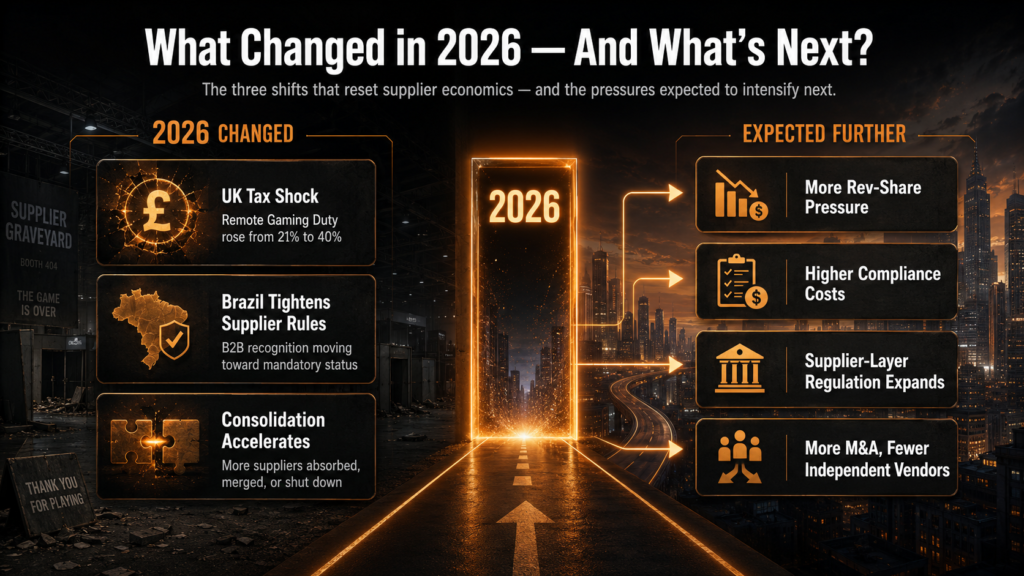
Any supplier strategy written before late 2025 is now operating on stale assumptions. Three developments reset the environment.
1. The UK tax shock flows straight through to suppliers
On 1 April 2026, UK Remote Gaming Duty rose from 21% to 40%, announced in the November 2025 Autumn Budget. A new 25% remote betting duty follows in April 2027; bingo duty was abolished; remote bets on UK horse racing stay at 15%. HMRC’s impact assessment identified roughly 310 affected businesses and assumed operators would pass through up to 90% of the increase to consumers. The package is projected to raise around £1.1bn a year by the end of the decade.
Most coverage framed this as an operator story. It is not, or not only.
When a UK-facing operator’s casino margin compresses by that much, three levers get pulled fast: marketing spend, headcount, and supplier cost. Rev-share renegotiation is not a risk on the horizon — it is a live process across the UK supply chain this year. If you are a content supplier with meaningful UK exposure and you have not modelled a repricing scenario, you are behind your customers’ finance teams, who modelled it in December.
The strategic implication for new entrants is sharper still: fixed-fee and GGR-share models behave very differently under a 40% duty regime. Operators under margin pressure prefer costs that flex with revenue. Suppliers under cash pressure prefer costs that don’t. That tension is now the central commercial negotiation in the UK market.
2. Brazil is closing the supplier layer
For the first eighteen months of Brazil’s regulated market — live since 1 January 2025 under Law 14,790/2023 — supplier compliance was an operator’s problem. If your supplier wasn’t certified, the operator’s licence was exposed. The supplier itself had no direct relationship with the regulator.
That is changing. The Secretariat of Prizes and Betting (SPA) ran a public consultation from 4 February to 23 March 2026 on a draft ordinance establishing mandatory recognition for five categories of B2B supplier — covering betting systems and platforms, online game supply including aggregators and live studios, and player identity and related services. Recognition would be granted by individual ordinance for a three-year term, and once in force, licensed Brazilian operators would only be permitted to engage recognised suppliers.
Status note: the final ordinance text should be re-verified before you act on this. The direction of travel, however, is not in doubt.
The practical point for suppliers: “we serve Brazil” is becoming a licensing position with a local entity, a filing, a renewal cycle and a cost base attached — not a slide. Suppliers without a Brazilian legal entity are already on a clock that no amount of reading the final text will reverse.
Expect this pattern to replicate. The supplier layer is where regulators go next, because it is the chokepoint.
3. Consolidation is the dominant exit, not the exception
The last twelve months of supplier-side activity tell the real story of where sub-scale companies end up:
- IGT confirmed it will close its electronic table games division in 2027, following its combination with Everi under Apollo Global Management, after cutting roughly 10% of its workforce.
- EveryMatrix acquired front-end specialist Goma Gaming.
- Kambi acquired PAM source code from OMEGA Systems.
- Sportradar completed its acquisition of IMG Arena.
- Evolution terminated its long-running pursuit of Galaxy Gaming in July 2026 after the agreement’s outside date lapsed, paying a $5.2m termination fee on a deal valued at roughly $85m.
That last one carries a lesson founders rarely price in. Evolution’s Galaxy deal was announced in July 2024 and died two years later, largely on regulatory timing across US state and international regimes. The opportunity cost of a two-year approval process is real even when the deal is immaterial. For a small supplier hoping to exit via trade sale, the equivalent delay is not an inconvenience. It is the entire runway.
Seven reasons suppliers fail
Reason 1: There is no repeatable route to market
This is the most common cause of supplier death and the least discussed, because it is the least flattering.
A press release, a LinkedIn cadence, one conference and a founder’s personal network is not a go-to-market. It is a set of activities. The test of a route to market is whether you can describe, in one sentence, the repeatable mechanism by which an operator goes from not knowing you exist to sending you production traffic — and then execute it again with a different operator, without the founder in the room.
Most suppliers cannot answer that question. They substitute activity for mechanism, and they run out of money while still busy.
Distribution is not a feature. It is the business. A supplier with average technology and excellent distribution will outperform a supplier with exceptional technology and none. The graveyard is full of good products nobody found.
Reason 2: The product is not differentiated in a dimension operators care about
“We’re building a sports betting platform.”
Several hundred companies could say the same sentence today. Most target operators already have a sportsbook partner, an integration backlog, and a compliance team who will need to re-certify anything new.
To displace an incumbent, marginally better is worthless. You need to be transformationally better in a dimension the operator’s P&L actually responds to — margin on a specific bet type, time-to-market in a specific jurisdiction, approval rate on a specific payment corridor, retention in a specific player segment. “Better UX” is not a dimension. It is a hope.
Reason 3: Chasing every market at once
“We serve Africa, Latin America, Europe, Asia and North America.”
Delivered confidently, this sentence tells an experienced buyer one thing: we have not yet found the place where we are genuinely competitive.
Geographic concentration is not a limitation to apologise for. It is the entire basis of defensibility for a sub-scale company. As we documented in our guide to the African iGaming market, the lottery technology companies that dominate African national lotteries arrived with deep expertise in the specific formats those markets run. The resulting contracts are close to undisplaceable.
Trying to be everywhere means being defensible nowhere — and, increasingly, it means being non-compliant somewhere.
Reason 4: Treating conferences as an acquisition channel
Let’s model this honestly. The figures below are a scenario, not researched market pricing — build your own with your own quotes.
| Cost item (modelled) | Range |
| Booth space, 20m² | €20,000 – €35,000 |
| Stand design and build | €15,000 – €30,000 |
| Travel and accommodation, 5 staff, 3 nights | €10,000 – €15,000 |
| Marketing materials and collateral | €3,000 – €5,000 |
| Client entertainment | €5,000 – €10,000 |
| Total per event | €53,000 – €95,000 |
A typical return for a new supplier: 200–400 badge scans, 20–40 conversations that felt interesting, 5–10 follow-up meetings that actually get diarised, and 0–2 contracts signed within six months.
Now run the break-even. At €75,000 a show and three shows a year, that is €225,000. If your average first-year contract value is €60,000 and you close two deals a year from conferences, you are underwater on a fully-loaded basis before you have paid a single engineer.
The suppliers who dominate use conferences completely differently. They are not there to be discovered. They are there to compress twelve months of relationship maintenance into three days with clients they already have. That is a genuinely high-return use of €75,000. Customer acquisition from a cold floor is not.
The alternative allocation is worth stating explicitly: the same €225,000 funds a senior commercial hire with existing operator relationships for a year, or two aggregator integrations plus the certification stack to support them. Both convert to revenue more reliably than a booth.
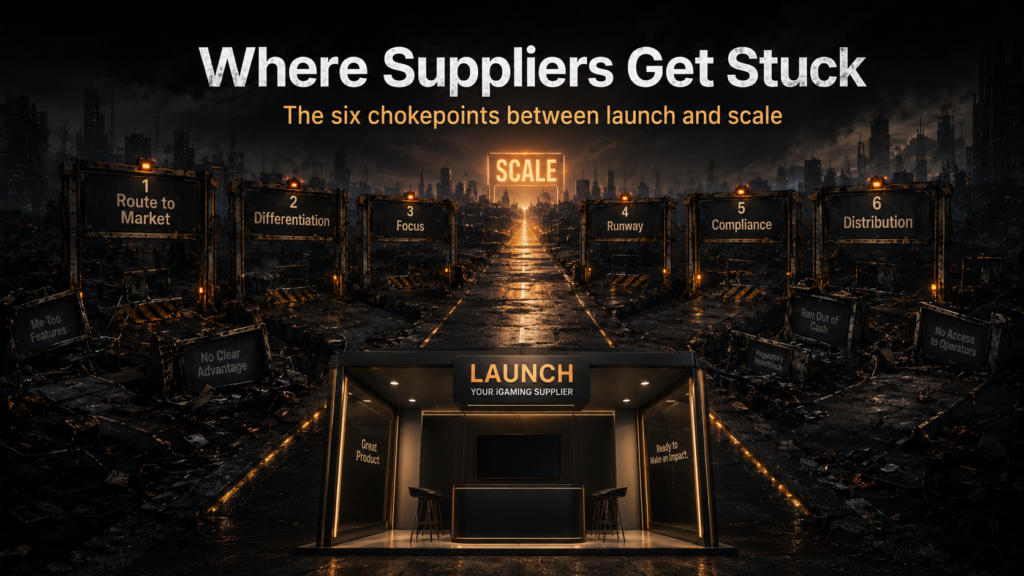
Reason 5: Selling features when operators buy outcomes
“We have 10,000 games.” “We have a modular API architecture.” “We’re AI-powered.”
That last one has become actively counterproductive. By 2026, near-universal AI claims across the exhibition floor have trained operator commercial teams to discount the phrase entirely. If your differentiation is a model, the burden is now on you to show the delta, in the operator’s own metrics, on their own data.
Operators buy: higher retention in a defined segment, faster time-to-market in a named jurisdiction, better conversion on a specific deposit funnel, lower churn among high-value players, fewer compliance incidents.
“Our crash portfolio lifted average session length 23% across three African operators over six months” is a purchasing conversation. “We have 47 crash titles” is a brochure.
Reason 6: Mistaking interest for intent — and under-capitalising the real cycle
“We had 40 conversations at SBC. Pipeline looks strong.”
Those forty conversations typically decompose into: people who wanted the branded pen; operators who will never switch; people who are vaguely curious about a future RFP; competitors gathering intelligence; and two or three genuinely qualified prospects who will not decide for nine months.
Platform deals run 12–18 months from first contact to signature. Aggregator penetration for a new studio runs 18–24 months to meaningful revenue. These numbers are not negotiable through enthusiasm.
The founders who run out of cash at month eleven were not unlucky. They were capitalised for an imagined sales cycle rather than the observed one. If you raise for eighteen months and your sales cycle is eighteen months, you have raised for zero months of revenue.
Reason 7: The compliance cost floor, and what happens when you cross it
Certification terminology matters here, because getting it wrong in a pitch signals inexperience to exactly the wrong audience. GLI is an independent test laboratory — it tests and certifies products against a jurisdiction’s technical standards; it does not “approve” companies. The MGA issues licences, including B2B critical gaming supply licences. The UKGC licenses gambling software suppliers and enforces the Remote Technical Standards.
Each jurisdiction stacks its own combination of testing, licensing, local entity, local hosting, reporting integration and annual fees. A supplier claiming thirty markets while certified in three is not a thirty-market supplier — and under Brazil’s emerging framework, that claim stops being marketing exaggeration and becomes a compliance exposure for their customers.
The consequences scale with size in a way that should frighten small suppliers. In July 2026, Evolution settled a UKGC licence review for £4.75m, concluding an investigation opened in December 2024 after its content was found reaching six unlicensed sites via two operators. Evolution absorbed that. A supplier with €4m of annual revenue would not have absorbed it — and the terms-of-supply failure that caused it is exactly the kind of control that under-resourced commercial teams skip.
Compliance is a fixed cost that scales terribly. It is the single most underestimated line in every supplier financial model I have seen.
The other side of the table: how operators actually decide
The article most suppliers need is not about suppliers. It is about the room where the decision gets made — and that room works differently from how vendors imagine.
Nobody says no. They say “not this quarter.” A commercial yes is not a technical yes. Enthusiasm from a commercial director means almost nothing until the integration has a slot.
The binding constraint is roadmap capacity, not switching cost. Most operator technology teams carry twelve to twenty-four months of committed backlog. A new supplier is not competing with the incumbent supplier. It is competing with every other item in the sprint queue — including regulatory work that cannot be deprioritised, because a missed compliance deadline costs a licence and a missed vendor integration costs nothing.
This is why “our product is better” so often fails to move anything. Better is not the criterion. Displacing something already scheduled is the criterion.
There is usually more than one veto. Commercial wants the revenue. Technology owns the integration cost. Compliance can kill it outright and rarely has to justify itself. Finance asks what it replaces. A supplier who has only won commercial has won nothing.
Five questions to be able to answer in a single sentence each:
- What does the operator stop doing, or stop paying for, if they adopt you?
- How many engineering days does integration cost them, and who is providing them?
- Which jurisdictions are you certified in today — not in progress, today?
- What happens to their licence exposure if your terms of supply are breached?
- Who else in their peer group already runs you in production?
Question five is doing more work than the other four combined. In a low-trust, high-consequence purchase, reference weight beats feature weight every single time.
The economics nobody publishes
Three structural realities that determine whether a supplier survives long enough for strategy to matter.
The revenue chain is longer than founders model. A game studio distributing through an aggregator into an operator is third in line on a share of GGR that has already been reduced by tax and by the operator’s own margin requirement. Under a 40% duty regime in a market like the UK, every party in that chain is renegotiating simultaneously. If your model assumes the split you signed in 2023 holds through 2027, rebuild it.
Working capital kills companies that are winning. Operators commonly settle on 30–90 day terms. Suppliers carry the float on delivered revenue while paying engineers monthly. A supplier growing quickly can fail on cash while profitable on paper — and this is a more common cause of death than losing deals.
Customer concentration is the risk you cannot diversify quickly. One client at 40% of revenue means your enterprise value is a function of their renewal decision, and any acquirer will discount for it heavily. Worse, supplier failure caused by customer failure is common and almost never discussed publicly. When an operator exits a market — and 2026 has produced plenty of that under UK and European margin pressure — their suppliers absorb the loss with no announcement and no sympathy.
Why some suppliers become giants — and what happens next
The survivors are not the best-funded or the most feature-rich. They are the most precisely positioned. But the full lesson only becomes visible when you follow them past the point of winning.
Evolution: a two-act case study
Act I is the story everyone tells. Evolution did not attempt slots, table games, live casino and virtuals simultaneously. It built live casino, built it better and faster than anyone, and built global studio infrastructure competitors could not replicate. By the time the market understood what had been assembled, Evolution had contracts with effectively every significant operator on the planet. It is the cleanest example of category ownership the industry has produced.
Act II is the part that gets left out — and it is more useful.
Having won the category, Evolution bought adjacency: NetEnt in 2020, then Red Tiger, Big Time Gaming and Nolimit City. The focus story became a portfolio story. And in 2026, the portfolio is where the growth is: in Q1, RNG revenue grew to €78.2m while live casino revenue fell.
The wider picture as of July 2026:
- H1 2026 net revenue of €1,030.8m, down 1.4% year on year; Q2 revenue €517.8m, down 1.2%
- Q2 EBITDA of €341.0m at a 65.9% margin — still extraordinary, still compressing
- Europe down 12% year on year in Q1, with CEO Martin Carlesund describing Europe as <cite index=”23-1″>the company’s main headache</cite>
- A £4.75m UKGC settlement in July 2026, concluding a licence review opened in December 2024
- The Galaxy Gaming acquisition terminated after two years, with a $5.2m break fee
- Roughly 870 operator customers and 22,900 employees across studios on four continents
Evolution is not in trouble. A 65.9% EBITDA margin is a fortress. But the lesson for a supplier founder in 2026 is not “focus and you will win forever.” It is more precise, and more useful:
Category ownership wins the land grab. It buys you time and margin. It does not exempt you from market maturity, regulatory cost, or the difficulty of the second act. Every category eventually stops growing. The question that determines what happens next is whether you built something adjacent while the winning was easy.
Pragmatic Play
Chose slots and executed relentlessly. Gates of Olympus. Sweet Bonanza. The Dog House. Not forty-seven titles of average quality, but a concentrated portfolio of exceptional performers operators could trust to generate GGR. The lesson is portfolio discipline: a small number of games that operators actively merchandise beats a large number that sit in a catalogue tail.
GeoComply
Built geolocation compliance technology for a US regulated market that did not yet fully exist. It bet on regulation arriving, built a real technical moat, and became the de facto standard before the category had a name. This is the highest-return strategy available to a new supplier and the hardest to fund, because you are asking investors to underwrite a market that does not exist yet.
Spribe and SmartSoft
Aviator and JetX effectively created the crash category — and did it by reading player behaviour in markets that Western studios were still treating as an afterthought. Fast, social, mobile-first, low-stake formats resonated in African and Latin American markets while European suppliers were still trying to distribute European slot mechanics into them. Both companies are in our iGaming Supplier Directory.
The consistent pattern across all four: they identified a category where they could be first or best, said no to everything else long enough to win it, and only then diversified.
The survival formula
- Category ownership over product range. Pick one thing. The most dangerous phrase in a supplier’s strategy session is “we could also do…”. Every one of them dilutes focus and blurs market position. Diversify after you own something, not before — that is the actual sequence in every case study above.
- Distribution before marketing. Before committing €75,000 to a booth, answer this: what is the specific mechanism by which an operator starts using this product? Aggregator relationships. Platform partnerships. White-label agreements. Reseller arrangements. Each is a distribution channel with a countable pipeline. “We will be discovered at ICE” is not.
- Market specialisation, defended with compliance. A payment provider that is the undisputed expert in African mobile money integration has a defensible position. A payment provider processing in 150 countries competes on price alone. In 2026, specialisation increasingly means licensed specialisation — depth in three jurisdictions you are actually recognised in beats claimed presence in thirty.
- Thought leadership as distribution, not decoration. The suppliers winning the content game are not publishing press releases. They are publishing genuine intelligence — market data, regulatory analysis, player behaviour research — that operators use. A supplier who helps an operator understand a market better than the operator’s own team has earned a relationship no feature set dislodges.
- Capitalisation calibrated to the observed cycle. Platform deals: 12–18 months. Aggregator penetration to meaningful revenue: 18–24 months. Add 60–90 day payment terms on top. Fund for the cycle you can observe, then add the compliance cost floor, then add a repricing scenario. If that changes what you can afford to build, it has done its job.
- Partnership multiplication. The fastest path to distribution at scale is not direct sales. It is becoming the preferred supplier of a company that already has distribution. Every supplier should be able to name the five organisations whose recommendation would change their business overnight — and should know exactly what each of those five needs.
The ten-question supplier diagnostic
Score each honestly: 2 = yes, evidenced · 1 = partially · 0 = no.
- Can you name the single category you intend to own, in five words, without conjunctions?
- Can you describe your route to market as a repeatable mechanism that works without the founder in the room?
- Do you know the specific operator metric your product moves, and can you show the delta with real data?
- Are you certified — not “in progress” — in every jurisdiction you claim to serve?
- Have you modelled an adverse rev-share repricing scenario in your top market?
- Is your largest client under 30% of revenue?
- Do you have at least eighteen months of runway measured from today, not from your last close?
- Can three named operators act as production references in your target segment?
- Have you modelled the working-capital float from your actual payment terms?
- Do you know what your business is worth to an acquirer, and who the three plausible acquirers are?
16–20: You are building a category owner. Protect the focus; the pressure to dilute it increases with every good quarter. 11–15: Viable, fragile. One or two structural gaps are consuming most of your risk. Fix those before adding product. 6–10: You are on the zombie path. This is survivable, but only if you choose it deliberately — usually by narrowing hard and positioning for absorption. 0–5: The runway question is now the only question. Answer it before the next roadmap meeting.
The uncomfortable conclusion
The next billion-dollar iGaming supplier almost certainly already exists. It is probably not the most technically sophisticated company in the space, and it may not be known to most people reading this.
What it has, or will build, is clarity. Clarity about which category it owns. Clarity about the problem it solves better than anyone else. Clarity about why an operator should disturb an existing relationship and spend engineering days it does not have.
But 2026 has added a second requirement to that old formula. Clarity is no longer sufficient on its own, because the cost of being in this industry has risen — in tax passed down the chain, in compliance that scales badly for small companies, in regulators moving from operators to the supplier layer beneath them.
The graveyard is not full of bad companies. It is full of unfocused ones — and, increasingly, of focused ones that were never capitalised for what focus actually costs.
So the question is not “what else can we build?” It is two questions:
What are we genuinely the best in the world at — and are we doing everything possible to make sure the right operators know it?
And then: can we afford to still be here when they finally decide?
Frequently asked questions
How long does it take to sign an iGaming operator? Platform and PAM deals typically run 12–18 months from first contact to signature. New game studios distributing via aggregators generally need 18–24 months to reach meaningful revenue. Add 30–90 day payment terms on top when modelling cash.
Why do most iGaming suppliers fail? The dominant cause is no repeatable route to market, followed by under-capitalisation relative to the real sales cycle, undifferentiated product, geographic over-extension, and an underestimated compliance cost floor. Technology quality is rarely the primary cause.
Are conferences worth it for iGaming suppliers? For established suppliers with an existing client base, yes — they compress a year of relationship maintenance into three days. As a primary cold-acquisition channel for a new supplier, the break-even maths is very difficult: roughly €75,000 per show against typically 0–2 signed contracts within six months.
What does the UK’s 40% Remote Gaming Duty mean for suppliers? Duty rose from 21% to 40% on 1 April 2026. Operators facing that compression pull three levers — marketing, headcount and supplier cost — which means active rev-share renegotiation across the UK supply chain and increased pressure toward revenue-linked rather than fixed-fee pricing.
Does Brazil require B2B suppliers to be licensed? Brazil’s SPA consulted between 4 February and 23 March 2026 on a draft ordinance creating mandatory recognition for five categories of B2B supplier, granted for three-year terms, after which licensed operators could only engage recognised suppliers. Verify the final ordinance status before acting.
Is being acquired a failure for an iGaming supplier? No. Absorption is one of the most common and frequently the best outcome. The genuinely poor outcome is the zombie state — solvent, sub-scale, flat, and unattractive to acquirers.
Sources
- ICE Barcelona 2026 attendance, exhibitor and World Gaming Week data — Clarion Gaming (icegaming.com); Yogonet; Gambling Insider
- SOFTSWISS Game Aggregator scale and jurisdiction coverage — SOFTSWISS company announcements, 2025–26
- Global market sizing — H2 Gambling Capital; Grand View Research; Research & Markets
- UK gambling duty reform — HMRC policy paper, 26 November 2025; HM Treasury Autumn Budget 2025; Deloitte Taxscape
- Brazil B2B supplier recognition — SPA draft ordinance, Brasil Participativo consultation, 4 February – 23 March 2026
- Evolution AB Q1, Q2 and H1 2026 results — Evolution AB interim reports and investor materials
- Evolution UKGC settlement and Galaxy Gaming termination, July 2026 — UK Gambling Commission; SBC News; NEXT.io
- Supplier consolidation activity — iGaming Business; SCCG Management; company announcements
Figures verified as at 24 July 2026.
Are you an iGaming supplier? List your company free in the iGaming People Supplier Directory — reach 36,000+ industry professionals.
Related reading: