
In every major regulated market on earth, the operators who followed the rules are quietly losing to the ones who never bought a seat at the table. The channelisation numbers tell a story nobody in a compliance department wants to read out loud — and the industry is running out of time to pretend otherwise.
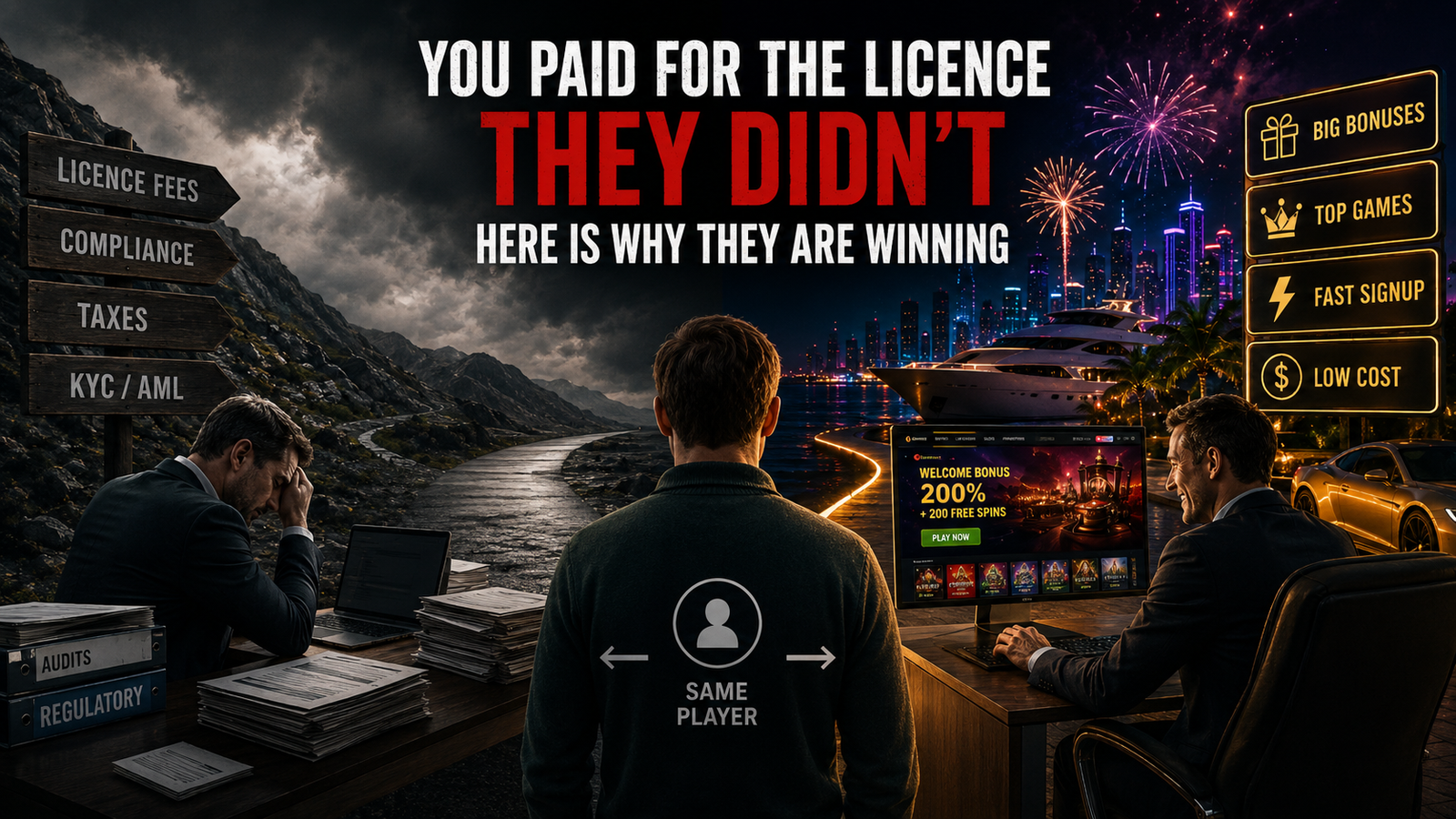
The first one did everything right. It applied for a national licence, waited months, paid the fees, wired the security deposit. It runs affordability checks, honours deposit limits, files the suspicious transaction reports, funds the responsible gambling tools, and hands over a third or more of its gross gaming revenue in tax. Its marketing copy is lawyered to the comma. Its welcome offer is capped, caveated, and barely worth mentioning.
The second one holds a licence from a Caribbean island with no gaming tax — or no licence at all. It pays no local duty. It runs no affordability checks. It onboards a player in ninety seconds with a crypto wallet, hands them a bonus the licensed operator is legally forbidden to match, and finds them through a Telegram channel and an influencer the regulator cannot touch.
Same player. Same game. Same odds on the same slots.
One operator is carrying a bag of bricks up the hill. The other is already at the top, waving.
This is the defining commercial problem of regulated iGaming in 2026. And almost nobody wants to say it plainly: doing it properly has become a competitive disadvantage.
The One Number That Tells the Whole Story
If you want to know how a regulated market is really doing, ignore the press releases and look at one metric: channelisation.
It is the share of all gambling money that actually flows through licensed, taxed, supervised operators — rather than to the offshore and unlicensed sites the regulator cannot see. High channelisation means the system works. A falling number means the money is walking out the door — and taking the player protection with it.
Here is what that number looks like across the “gold standard” markets in 2026.
The Netherlands re-regulated with high hopes in 2021. Its own regulator, the KSA, now estimates that channelisation has slipped below 50% for the first time — roughly one in every two euros wagered online is going to operators it does not license. In one of Europe’s most carefully designed regulated markets, the black and grey market is now nearly as big as the legal one.
Sweden is the cautionary tale everyone quotes. After re-regulation in 2019, channelisation was estimated at around 91%. By 2026, H2 Gambling Capital had revised that estimate down to roughly 72%. The country’s own online gaming trade body has called the situation “critically low.” The national target was 90%. The line is pointing the wrong way.
Germany, depending on who is counting and which product, sits somewhere between 50% and 77%. Its licensed online casinos operate under a €1-per-spin cap on slots, a five-second minimum between spins, a €1,000 monthly deposit ceiling, and for most licences, no live casino at all. Every one of those rules is a reason for a serious player to look elsewhere.
The United Kingdom — the most heavily regulated online gambling market on earth — now has an estimated 1.5 million people betting on unlicensed sites, worth around 9% of the market and roughly £4.3 billion in annual stakes. Nine percent. In the country that wrote the book on gambling regulation.
Put it together and the picture is brutal. In the markets that regulate hardest, up to half the money is escaping the system entirely.
The promise regulators made to honest operators was straightforward: we will license you, tax you, and in return we will keep the rule-breakers out. Across market after market, the first half of that deal was honoured and the second half quietly was not.
The Maths of the Handicap
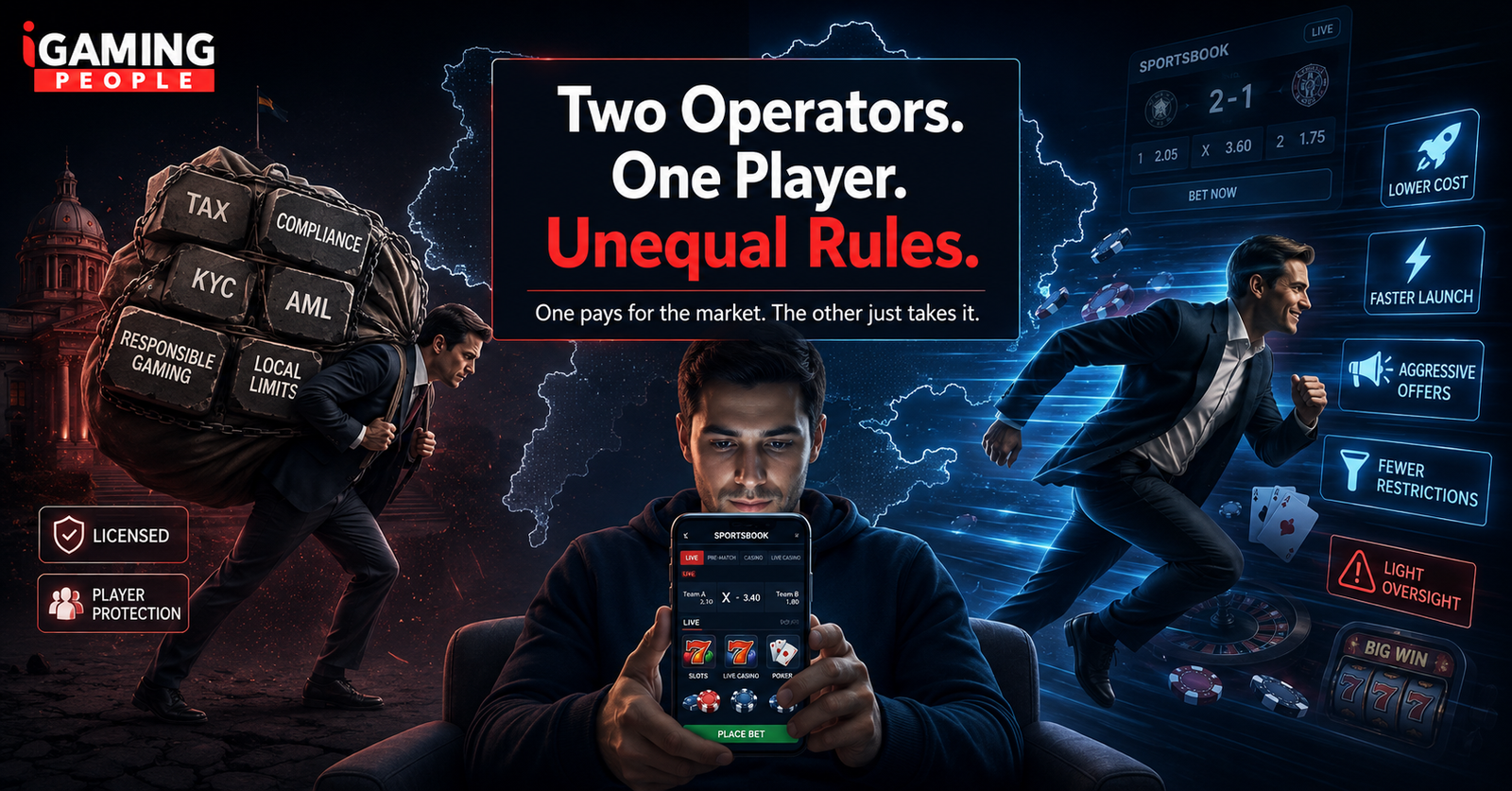
None of this is because unlicensed operators build better products. It is because they carry a fundamentally lighter cost structure — and in a commoditised market, cost structure is destiny.
Look at what a licensed operator pays before it has acquired a single customer.
In the Netherlands, gaming tax on gross gaming revenue sits at 37.8%. In the United Kingdom, Remote Gaming Duty jumped from 21% to 40% in April 2026 — nearly doubling overnight. On top of that sit licence fees, annual supervision levies, mandatory responsible gambling infrastructure, KYC and AML systems, affordability checks that resemble a mortgage application, and the compliance headcount to run all of it.
As we documented in our iGaming License Guide 2026, the cost of holding a single Tier 1 jurisdiction licence now runs into millions of euros annually before a single bet is taken.
Now look at the other side of the table.
An operator licensed in Curaçao pays no gaming tax on GGR — that has always been the jurisdiction’s central selling point. An operator flying the flag of Anjouan can be operational for a flat fee in the region of €18,000 a year. An operator with no licence anywhere pays nothing to anyone.
When one competitor surrenders 40% of gross revenue to the state and the other surrenders zero, they are not in the same business. They are barely in the same universe.
That gap does not go into the shareholders’ pockets. It goes straight back onto the table as bigger bonuses, higher limits, faster payouts, and heavier marketing. The offshore operator can simply outspend the licensed one for the same customer, indefinitely, and still come out ahead.
“Licensed” and “Licensed” Are Not the Same Word
Part of what makes this situation so maddening for compliant operators is that many of their rivals technically are licensed. They just hold a licence that means something entirely different.
For two decades, Curaçao was the flag of convenience for the entire industry. Under its old system, four private master-licence holders sold thousands of sub-licences to operators around the world, with minimal oversight and near-zero enforcement. At its peak there were more than 3,000 active sub-licences on the books. A “Curaçao licence” was less a regulatory approval than a rubber stamp available for rent.
That system is now being dismantled. Curaçao’s new LOK law, passed in December 2024, killed the master/sub-licence model and forced operators to apply directly to a new regulator — the Curaçao Gaming Authority — with real AML and player protection obligations attached. On paper, it is a genuine upgrade.
In practice, it has been chaos. The regulator’s entire supervisory board resigned in September 2025. The finance minister who drove the reform left office amid corruption allegations a month later. Operators who followed the new rules are still waiting on final decisions. And operators who wanted to avoid the hassle simply moved their base to the next cheapest jurisdiction — Anjouan, Nevis, Costa Rica — treating the choice of licence as a shopping decision about price and speed rather than accountability.
That is the uncomfortable truth behind the word. For a significant portion of the offshore market, a licence is not a promise to the player. It is an address of convenience. And when it shares the same word your national regulator uses, the distinction is invisible to the customer — which is exactly the point.
The Weapons You Are Not Allowed to Use
Here is where it turns from unfair to almost absurd.
The two most powerful tools any operator has for winning a customer — a generous welcome offer and loud, visible marketing — are precisely the two tools regulators are removing from licensed operators, and precisely the two the offshore competition wields without restriction.
The Netherlands is drawing up plans to end sign-up bonuses entirely and ban gambling advertising altogether. The intention is player protection. The likely effect is a gift to the black market.
The country’s own regulator has warned against a total advertising ban. Industry figures point out the obvious: an estimated 95% of gambling advertising already circulating on Dutch social media comes from illegal operators. Ban the licensed brands from advertising, and you do not silence gambling promotion — you hand the entire megaphone to the operators who have never been in the conversation with regulators in the first place.
Meanwhile the offshore operator markets through exactly the channels a national regulator cannot reach: affiliate networks, search engines, influencer partnerships, and Telegram groups that live outside any jurisdiction. It offers the large bonus, the high limit, the instant crypto payout, and skips the affordability check that makes the licensed experience feel like applying for a mortgage.
And if a regulator tries to block the site at the ISP level, a determined player defeats it with a VPN in about thirty seconds.
Every rule written to make the licensed product safer also makes it slower, smaller, and less appealing. Every one of those rules is a reason for a determined player to find the same game somewhere without them. That is not an argument against player protection. It is an argument that protection which only binds the honest half of the market does not protect anyone. It simply redirects them.
What It Is Actually Costing — The Numbers Behind the Narrative
This is not a theoretical debate happening in policy papers. It is appearing in the accounts.
Holland Casino, the Dutch state operator, reported pre-tax profit falling by around €27 million in 2025 and a further €54 million in 2026, with visits down roughly 11% year on year. Several operators across Europe have trimmed their physical footprint or closed venues outright, citing the tax and compliance load as a direct cause.
In Sweden, licensed-market growth has flattened to well under 1% while operators absorb higher taxation and watch market share bleed to sites they cannot compete with on price.
And the global backdrop dwarfs all of it. A widely cited 2026 industry report put the total unregulated gambling handle worldwide at around $5.9 trillion. The direction is not in dispute: the shadow market is not a rounding error the legal industry is slowly absorbing. In many places it is growing faster than the legal one.
As we analysed in our Hidden Economics of iGaming, the operator margin in regulated European markets is already under severe pressure from game studio rev shares, affiliate commissions, and platform costs — before a single euro of tax is paid. Add a 40% GGR tax and the business case for compliance becomes genuinely difficult to make in a board meeting.
Regulators set out to shrink the black market by building a better legal one. In too many markets, they have done the opposite — they have made the black market the better deal.
The Africa and LATAM Contrast — What Happens When the Balance Works
The picture is not uniformly bleak. Two of the fastest-growing iGaming regions in the world offer a different lesson.
In Africa — where Super Group earns approximately 37% EBITDA margins from its regional operations, nearly double Flutter’s global 17.4% — channelisation problems are less acute in part because the regulatory frameworks are younger and lighter. As we covered in our Africa iGaming deep dive, national lottery operators in Ghana, Nigeria, and Kenya operate with tax structures in the 10–20% GGR range rather than 37–40%. The regulatory burden that is strangling European licensed operators simply has not yet arrived in most African markets.
The lesson is not that Africa has no regulation. It is that the balance between what a licensed operator pays and what it receives in return — a functioning enforcement environment, meaningful exclusion of unlicensed competitors — determines whether the licensed channel is commercially viable. In Africa, that balance is broadly intact. In the Netherlands and the United Kingdom in 2026, it is not.
Latin America, as we documented in our complete LATAM guide, presents a different warning. Brazil’s newly regulated market — the most watched iGaming jurisdiction of 2025–2026 — is already showing signs of the European channelisation trap: strict product rules, high compliance costs, and a grey market that existed before regulation arrived and has not disappeared since. The operators who get Brazil right from the beginning are building compliance architectures that can survive heavy regulation. The ones who cut corners are creating the same race to the bottom that is now costing European operators billions.
So What Does a Licensed Operator Actually Do?
There is no clean escape, and anyone selling one is not being honest. But the operators who survive this squeeze tend to be doing some combination of four things.
They fight for enforcement, not just rules. The single biggest lever is not tightening the licensed market further — it is raising the cost of operating illegally. That means payment blocking, domain seizures, and targeting the affiliates and processors that feed the offshore funnel. The UK’s Illegal Gambling Taskforce, which pulls in Google, Visa, Mastercard, and TikTok, is the right structure. Its £26 million budget over three years against a multi-billion-pound illegal market is almost certainly the wrong scale. Operators who want to survive should be lobbying loudly for the second part.
They make the proportionality argument, with data. Denmark is the counter-example the entire industry should be citing: it holds strong channelisation not by regulating hardest, but by keeping tax, product rules, and enforcement in a workable balance so the legal option stays commercially attractive. Every deposit cap and bonus restriction has a channelisation cost. Licensed operators now have the data to show regulators exactly where “more protection” tips into “more black market.”
They compete on the ground they can actually win. The one thing an offshore operator cannot credibly offer is trust — guaranteed payouts, segregated player funds, real dispute resolution, a brand that will exist next year. For a meaningful segment of players, that matters deeply. It is the licensed operator’s only durable competitive advantage, and most of them underplay it significantly.
They stop treating the offshore threat as someone else’s problem. For years the industry treated channelisation as a regulator’s key performance indicator. It is not. It is a market-share report — and right now it is reporting consistent losses quarter after quarter.
The Bottom Line
The players have not disappeared.
They have found a version of the same game where the house pays no tax, follows no rules, and answers to no one.
The operators and suppliers building durable businesses in 2026 — in regulated Europe, in emerging Africa, in newly legal Brazil — are the ones who understand that winning those players back is not a compliance exercise. It is the whole business.
The shadow market has been dodging enforcement for twenty years. When that finally changes — and the political and commercial pressure building across the US, UK, and EU suggests it will — the licensed operators still standing will be the ones who understood the fight they were actually in.
The question is how many of them survive long enough to see it.
The iGaming People covers the global iGaming industry with a focus on data, insight, and the people behind the business. Follow us on LinkedIn for daily updates.
Related Reading:
- The Hidden Economics of iGaming — Who Really Makes the Most Money?
- iGaming License Guide 2026 — From €7,000 to €800,000
- iGaming Latin America 2026 — The Complete Operator’s Guide
- From Ghana to Nigeria: The $5.6 Billion Lottery Story
SOURCES:
- Netherlands channelisation below 50% — KSA 2025 Annual Report, gamingcompliance.io
- Sweden channelisation 91% → 72% — H2 Gambling Capital, playerprotectionhub.com
- Germany channelisation 50–77%, product caps — brightsideofnews.com, henkwolff.com
- UK black market 9%, 1.5m players, £4.3bn — igamingpulse.media, brightsideofnews.com
- UK Remote Gaming Duty 21% → 40%, April 2026 — ccn.com
- Netherlands 37.8% GGR tax, proposed ad/bonus ban — igamingbusiness.com
- “95% of Dutch gambling ads are illegal” — igamingbusiness.com
- Curaçao LOK reform, 3,000+ sub-licences, regulatory crisis — legarithm.io, fastoffshore.com
- Anjouan licence ~€18,000/year — zitadelleag.com
- Holland Casino profit decline €27m + €54m — focusgn.com
- $5.9 trillion unregulated gambling handle — gamingcompliance.io GCI 2025 Global Report
- Super Group Africa EBITDA ~37% — Super Group Q1 2026 investor report
- Flutter Entertainment global EBITDA 17.4% — Flutter FY2025 annual results
- UK Illegal Gambling Taskforce, £26m budget — UKGC announcement 2026
- Denmark channelisation model — H2 Gambling Capital, Spillemyndigheden annual report