




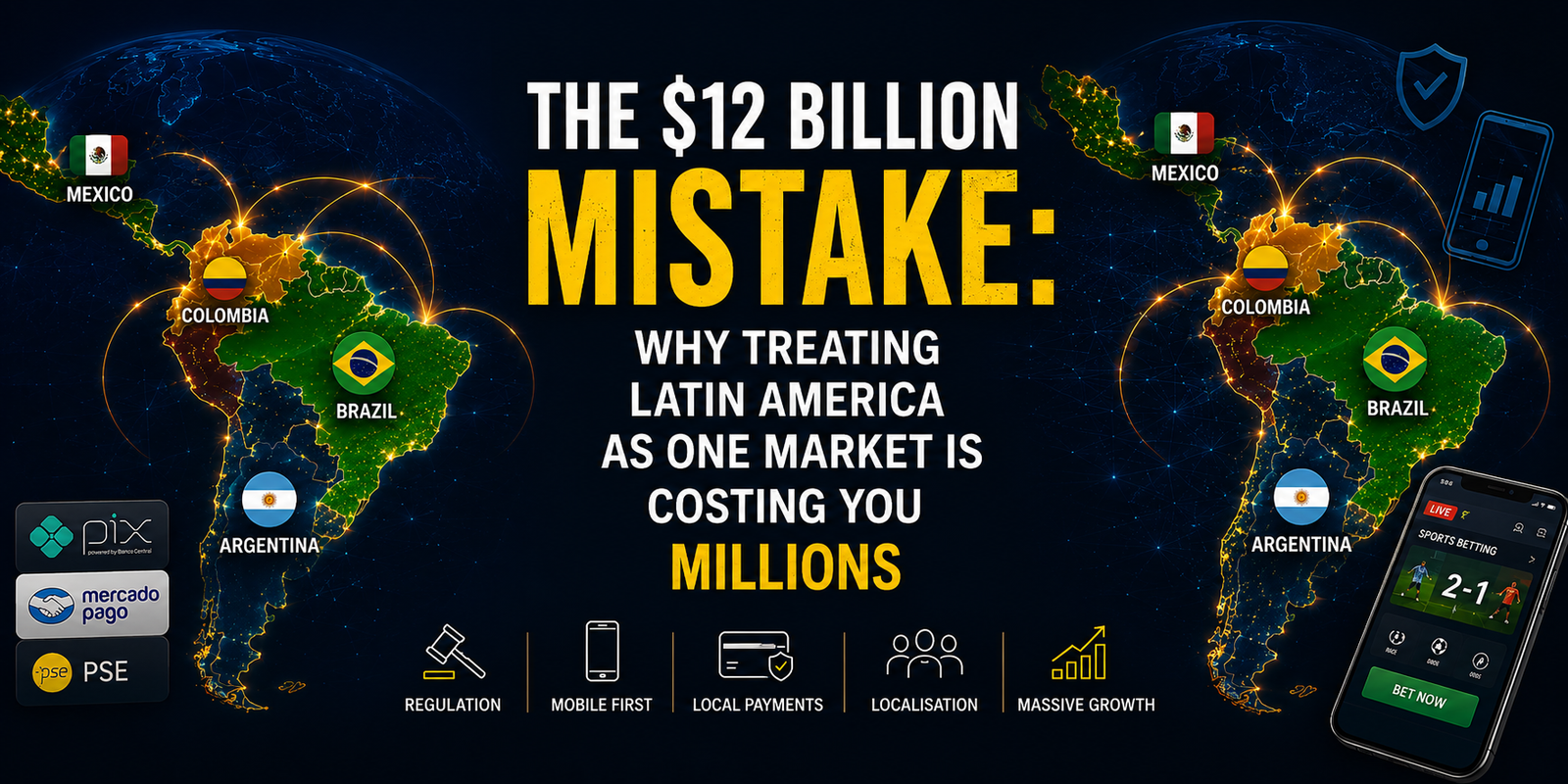
Every operator wants a piece of Latin America. Most of them get it wrong. They land in São Paulo thinking they understand Brazil because they once operated in Spain. They assume Colombia works like Mexico. They treat a continent of 670 million people — speaking different languages, playing different games, using different payment methods, trusting different brands — as a single addressable market. That mistake is expensive. This article is for the ones who want to get it right.
The Numbers First — Because They Are Extraordinary
Let us establish the scale of what we are talking about.
The Latin American iGaming market reached approximately $6 billion in 2025, primarily driven by Brazil, Mexico, and Chile — and is projected to surpass $10-$12 billion by 2028.
The total market is underpinned by a compound annual growth rate (CAGR) of 18.4% between 2022 and 2028.
Mexico alone recorded over 55% year-over-year growth, while the broader region continues to expand at an estimated 11% compound annual rate.
Brazil experienced the most significant increase in online betting visits at 96.66%, followed by Argentina at 63.58%, Peru at 55.66%, Chile at 27.33%, and Colombia at 12.96%.
These are not emerging market numbers. These are the growth rates of a market in full acceleration — and the operators who moved early are already building moats.
Why LATAM Is Different From Every Other Market
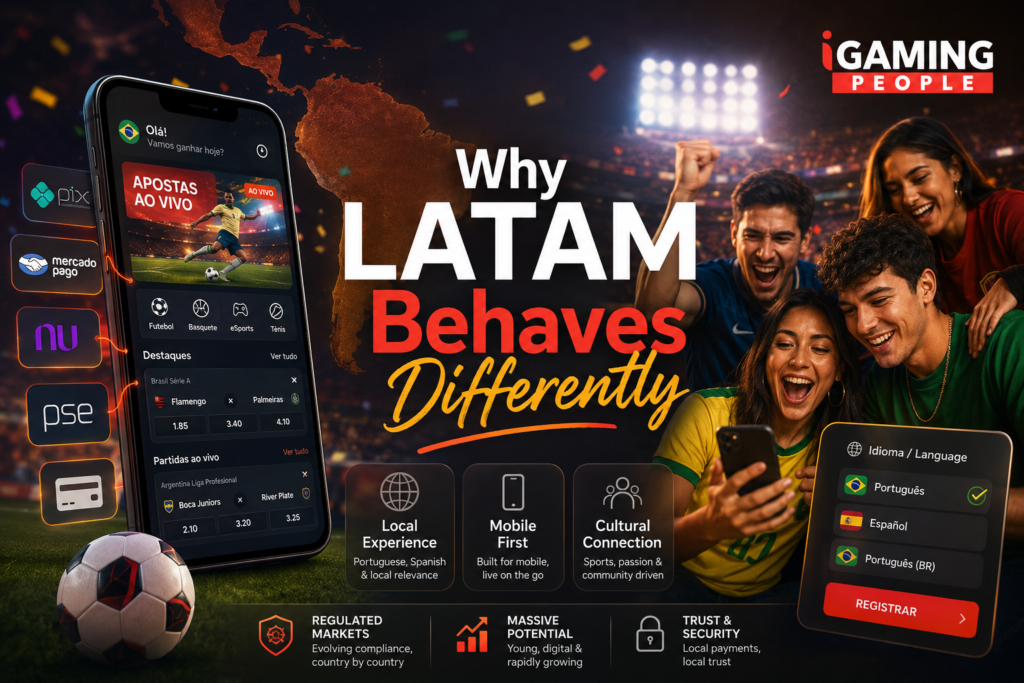
Before diving into country specifics, there are three structural realities that define the Latin American iGaming opportunity — and separate the operators who succeed from those who do not.
1. Mobile Is Not an Option — It Is the Only Option
The Latin American mobile gaming market is projected to reach $4.5 billion by 2025, with mobile accounting for over 70% of total gaming revenue. In 2024, the region led global install and session growth, even as mature markets plateaued.
This is a mobile-first, mobile-only market for most players. Not because they prefer it — because for tens of millions of Latin Americans, a smartphone is the only connected device they own. Any operator building a desktop-first product for LATAM is building for the wrong audience.
2. Football Is a Religion — And Betting Is Its Ritual
Sports betting in Latin America is arguably one of the few regions where it is paramount and sometimes even more influential than casino gaming. The population’s love of sports translates into a desire to support their favourite teams, which generates strong demand for sports betting services.
But football alone does not explain the depth of engagement. Esports, although less popular than traditional sports, is rapidly gaining ground among young audiences, especially in games such as League of Legends, Counter-Strike, and Free Fire. The Gen Z player in Brazil or Colombia is as likely to bet on a CS2 match as a Flamengo game.
3. Culture Is a Moat — Not a Marketing Checkbox
Players are doing more than just downloading — they are returning and spending more, particularly when operators localise language, payment methods, and cultural references. However, one critical reality is often overlooked by international entrants: Latin America is not a single market. Treating it as such is the most common and costly strategic error.
A Portuguese-language site with Brazilian payment methods will not convert Colombian players who use Spanish and pay with PSE. A football-first sportsbook designed for Argentina’s Buenos Aires audience will feel foreign to a player in northeastern Brazil whose loyalty is to a regional club nobody outside the country has heard of.
The Big Four — Country by Country
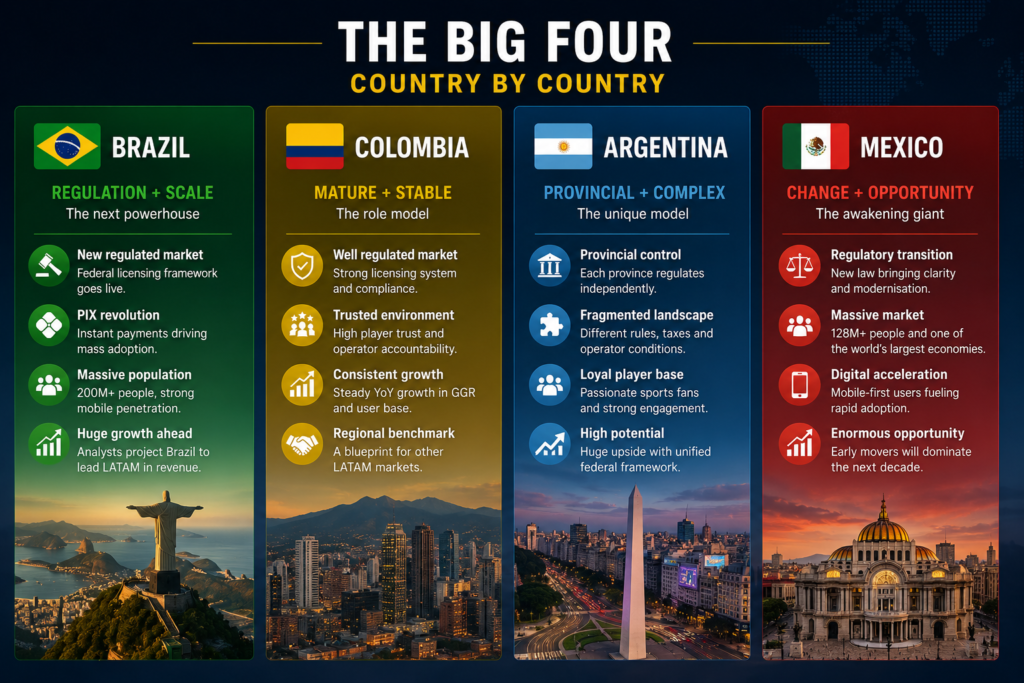
🇧🇷 Brazil — The Sleeping Giant That Just Woke Up
Brazil is in a category of its own. Brazil’s gambling market is not only the most significant in LATAM but also the single biggest regulated one globally. Gambling in Brazil generates an estimated annual turnover of BRL 50 billion — approximately USD 10 billion. Real-money games alone have seen substantial growth and have passed 100 million participants.
The popularity of gambling in Brazil is particularly noticeable among sports fans — more than 86% of those surveyed admitted to using online betting services, making the country one of the most attractive markets for iGaming operators.
The Regulatory Reality — 2026 Update
As of January 1, 2025, online betting and iGaming are regulated under federal law. Operators must hold a valid license from the Ministry of Finance to operate legally.
For operators, 2026 is not about obtaining a license — it is about keeping it. The SPA has already issued its first wave of fines for non-compliance, specifically targeting platforms with weak identity verification. The “grey market” era of Brazilian iGaming is officially dead.
The B2B Supplier License — Critical New Development
This is the most important regulatory development in Brazil right now — and most international guides have not yet covered it properly.
The Brazilian Secretariat of Prizes and Betting (SPA/MF) closed public consultation on its draft B2B Supplier Recognition Ordinance on 23 March 2026. The final rules have not yet been published. Suppliers and operators serving the Brazilian market are now in a six-to-eight week regulatory window where the obligations are visible, the timeline pressure is real, and most companies in scope are still waiting for clarity.
Five categories of B2B supplier are now in scope for direct SPA recognition: platform and PAM systems, sports odds engines, RNG and game providers, payment processors, and anti-fraud and KYC systems. Once recognition is in force, licensed Brazilian operators will only be permitted to engage suppliers who hold formal SPA recognition. Existing supplier contracts will need to terminate if the supplier fails to obtain it.
For any supplier currently serving the Brazilian market — or planning to — this is not optional. This is existential.
What You Need to Succeed in Brazil
- Local entity — operators must establish a company in Brazil with a minimum of 20% Brazilian capital
- Portuguese language — a site in Portuguese for Brazil is a must, since 98% of the population identifies it as their native language
- Local payments — most popular payment options for Brazil include PIX, Sodexo, and Boleto. Electronic wallets like Pay4Fun and Evino are also very popular among users
- No crypto — gambling with cryptocurrencies is officially banned in Brazil under the country’s new iGaming regulatory framework
- Mobile-first product — anything less is a commercial liability
- Tax readiness — operators pay a 12% GGR tax, up to 36% effective tax rate, and must withhold 15% on player winnings above BRL 2,824
Player Profile The typical Brazilian iGaming player has an average age of 39, is mostly male but with growing female participation. They are sports-first, mobile-native, and deeply brand-loyal once trust is established.
🇨🇴 Colombia — The Regulatory Pioneer Everyone Should Study
Colombia, the regulatory pioneer in the region, legalized online gambling in 2016 and now boasts 9.5 million unique online gambling users, with the industry contributing roughly 1.7% of national GDP.
Colombia was the first Latin American country to properly regulate online gambling — and its approach has created the most mature, most competitive, and arguably most sophisticated iGaming market in the region. As of recent data, Colombia’s sector included 20 national operators, around 360 local betting operators, 15 lotteries, and over 2,600 gaming establishments.
The Coljuegos Framework Colombia’s regulator, Coljuegos, operates one of the region’s most transparent licensing frameworks. International operators can obtain a local license, and the market welcomes foreign investment provided operators meet local compliance standards.
What Works in Colombia Colombia’s players are educated gambling consumers — they have had a decade of legal online gambling. They comparison-shop. They respond to loyalty programmes. They know what a good user experience looks like. Operators entering Colombia cannot rely on novelty — they need to compete on product quality, odds, promotions, and customer service.
Key Colombian payment methods: PSE (bank transfers), Nequi, Daviplata, and credit cards. PIX does not work here — this is a different market entirely from Brazil.
🇦🇷 Argentina — The Province-by-Province Puzzle
Argentina’s iGaming sector is estimated at US$2.5–3.36 billion annually, supported by a relatively high 25.87% adult market penetration and a base of 8 million active players.
Argentina’s regulatory landscape is uniquely complex — and uniquely rewarding for operators who navigate it correctly. Online gambling is regulated at the provincial level, not federally. This means entering Argentina is not one license — it is potentially 23 different licenses across 23 provinces.
In practice, the two most important jurisdictions are:
- Buenos Aires Province — largest population, most active gaming market
- Buenos Aires City (CABA) — separate regulator, LOTBA, highly regarded
Argentina boasts a rich gaming history, with Buenos Aires influencing its iGaming laws. By 2026, Argentina aims to establish some of the most comprehensive online gambling laws, allowing both domestic and international businesses to operate under a detailed licensing system — positioning it as a prime destination for iGaming investments.
The Argentine Player — Unique Characteristics Argentina’s economic instability has shaped a player base that is sophisticated about currency risk. Many Argentine players actively prefer USD-denominated accounts and cryptocurrency options — as a hedge against peso volatility. Operators offering USD wallet options have a significant competitive advantage in this market.
🇲🇽 Mexico — The Sleeping Giant With Regulatory Uncertainty
Mexico is the second-largest economy in Latin America, with a population of over 120 million. Mexico boasts impressive numbers, with annual turnover exceeding US$10 billion and a user base of around 80 million people.
Yet Mexico remains one of the most complex market entry challenges in LATAM. The country’s gambling law dates back to 1947 — in 2026, Congress is expected to revisit central initiatives, aiming to modernise Mexico’s gambling laws.
The practical reality: Mexico operates under a federal permit system administered by the Interior Ministry (SEGOB). The market is technically regulated but enforcement is inconsistent, and the grey market is significant. Reform discussions continue but legislative timelines remain unclear.
What Works in Mexico Esports betting is growing faster in Mexico than anywhere else in LATAM — driven by a young, digitally-native population and a strong gaming culture that predates online betting. Mexico has a rich history of gambling dating back to the Aztec empire, when they played a game called Patolli. Operators who connect their products to this deep cultural history of gaming build trust faster than those who arrive with purely international branding.
Player Behaviour — Lottery vs iGaming
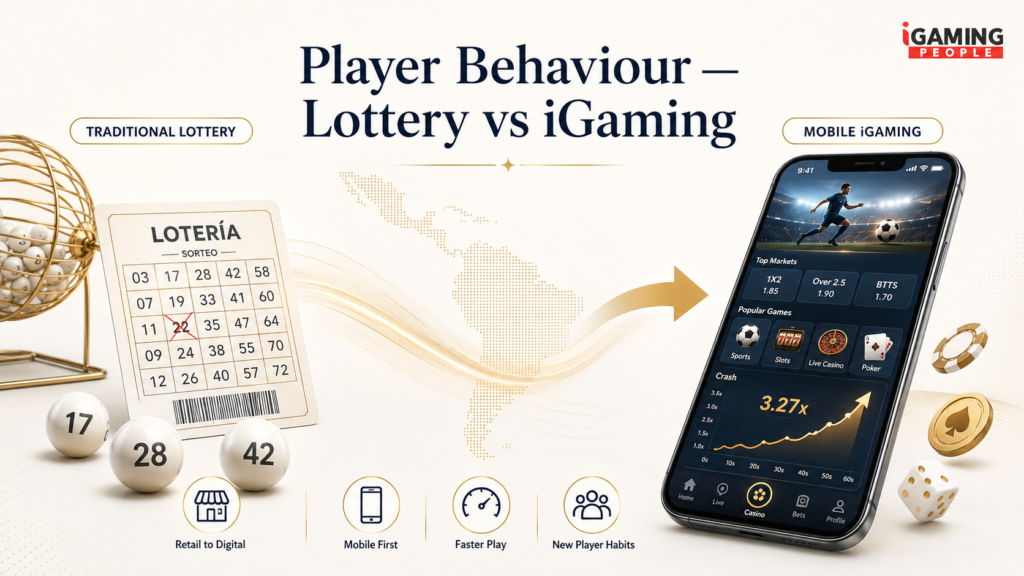
One of the most fascinating dynamics in Latin American gambling is the relationship between traditional lottery culture and modern iGaming. Understanding this dynamic is essential for any operator or supplier entering the market.
The Lottery Foundation
Key gambling verticals in Brazil include lotteries, sports betting, and casino games — with sports betting and lotteries leading in popularity.
Lottery is not just a product in Latin America — it is a cultural institution. A popular form of gambling in Brazil is the ‘Jogo do Bicho’ — a lottery game that has been around for more than 100 years. Bingo and lottery-style games are particularly popular in Mexico and Brazil.
This legacy matters enormously for product strategy. Latin American players who grew up on lottery understand number-based games intuitively. They are comfortable with fixed-odds formats. They respond to jackpot mechanics. Operators who ignore this heritage and launch purely with European-style slot-heavy casinos are missing a powerful acquisition lever.
The iGaming Transition
The shift from lottery to iGaming in Latin America is not a replacement — it is an expansion. The same player who buys a weekly lottery ticket is now also placing a football bet on their phone on Saturday and spinning a crash game on Tuesday.
Top casino games in Latin America include: slots — mobile-friendly and customizable; table games — blackjack and roulette retain strong followings; crash games — fast, high-risk formats popular among Gen Z players; fish games — arcade-style and visually engaging; and bingo and lotteries — especially popular in Mexico and Brazil.
For live casino, roulette is the most popular game, followed by blackjack and baccarat. Ensuring the availability of tables with dealers who speak Spanish — and for Brazil, Portuguese — is a key factor for success.
The Crash Game Phenomenon
Crash games deserve special mention. Games like Aviator, JetX, and Spaceman have become cultural phenomena in Brazil and across LATAM — driven by their simplicity, speed, and social sharing mechanics. A crash game is essentially a modern lottery with immediate gratification — it maps perfectly onto the risk tolerance and entertainment preferences of the Latin American player.
Any operator entering LATAM without a strong crash game offering in 2026 is leaving significant revenue on the table.
What You Need to Succeed in This Market
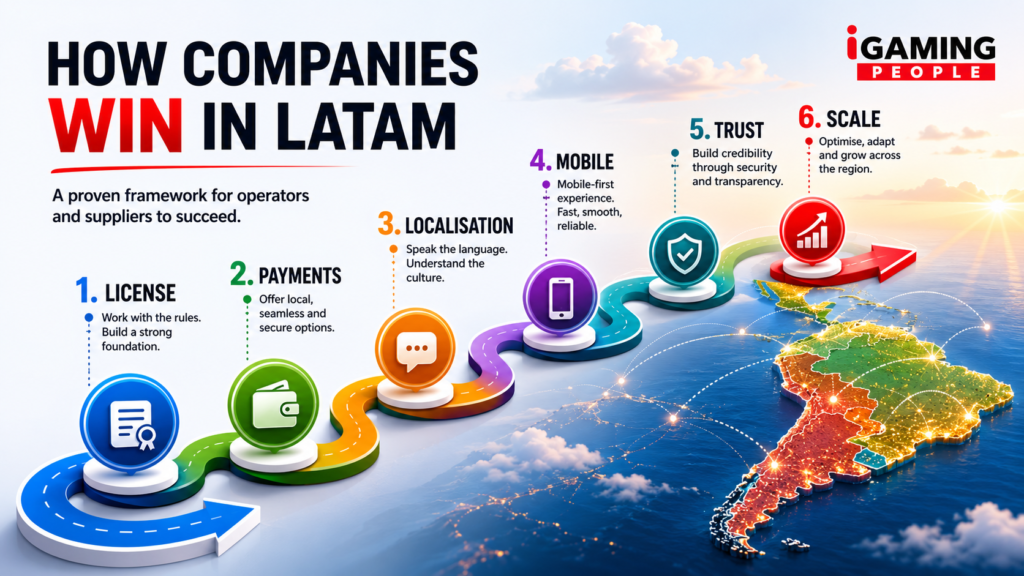
Across all LATAM markets, five factors consistently separate operators who win from operators who fail:
1. Localisation Is Not Translation Language is the starting point — not the finish line. True localisation means:
- Local payment methods fully integrated
- Local customer support in local time zones
- Promotions tied to local sporting events and cultural moments
- Odds presented in local formats
- Bonuses structured around local player behaviour
2. Payment Infrastructure Is Your Most Critical Partnership While 54% of Latin American consumers use digital payment methods, 46% still use cash. The payment landscape varies dramatically by country — PIX dominates Brazil, PSE dominates Colombia, OXXO Pay and SPEI dominate Mexico. An operator who does not integrate the dominant local payment method loses a significant percentage of potential deposits before the player ever sees the lobby.
3. Mobile Performance Is Non-Negotiable In markets where many players access iGaming on mid-range Android devices over inconsistent 4G connections, a product that requires a fast device and a stable connection will fail. LATAM-focused operators optimise for low-bandwidth performance, small app sizes, and fast load times on affordable hardware.
4. Regulatory Compliance Is Now a Competitive Advantage The grey market era is ending across LATAM. Those who combine regulatory agility, cultural fluency, and disciplined technology investment will not merely participate in this growth cycle — they will define it. Being licensed in Brazil, Colombia, and Argentina signals trustworthiness to players who have been burned by offshore operators who disappeared with their deposits.
5. Brand Building Requires Patience Latin American players are deeply brand-loyal — but that loyalty takes time to earn. Operators who arrive with short-term bonus wars and then retreat when margins compress leave nothing behind. The operators building durable businesses in LATAM are investing in brand awareness, community building, and long-term player relationships.
The Regulatory Direction — Where Is LATAM Heading?
The macro trend is unmistakable: Latin America is moving toward comprehensive regulation, market by market, at an accelerating pace.
Brazil — Fully regulated from January 2025, with B2B supplier licensing coming in 2026. The most advanced framework in the region.
Colombia — The mature model. A decade of licensed operation has produced a stable, competitive market. Tax reform is the key watchpoint for 2026.
Peru — Peru has shown robust growth with a well-defined licensing system introduced in 2024, a total player base of 5 million, and a market value close to US$2.5 billion.
Argentina — Provincial regulation is advancing. Buenos Aires Province and CABA lead the way. Federal framework discussions continue.
Mexico — Reform is coming but timing remains uncertain. The 1947 framework is clearly inadequate for the modern market.
Chile — A licensing bill introduced in 2022 continues through the legislative process. Passage expected before end of 2026.
For operators and suppliers, the strategic implication is clear: get licensed early, build compliance infrastructure properly, and treat regulatory relationships as long-term investments.
The Bottom Line — Why 2026 Is the Year to Act
Latin America is no longer a sleeping giant — it is wide awake and accelerating toward becoming one of the world’s most vibrant iGaming regions. Those who combine regulatory agility, cultural fluency, and disciplined technology investment will not merely participate in this growth cycle — they will define it.
The window for first-mover advantage in key markets — particularly Brazil and Peru — is open right now. In 18 to 24 months, the competitive landscape will look fundamentally different. The players who move in 2026 with proper licensing, proper localisation, and proper products will be the brands that players trust and regulators know.
Latin America is not one market. That is precisely why it rewards operators who do the work to understand each country deeply.
The opportunity is extraordinary. The work is real. The time is now.
The iGaming People covers the global gaming industry with a focus on insight, data, and the people behind the business. Follow us on LinkedIn and Twitter for daily updates.
Tags: iGaming Latin America, LATAM iGaming, Brazil iGaming, Colombia iGaming, Argentina iGaming, Mexico iGaming, iGaming regulation, Sports Betting LATAM, Lottery Latin America, iGaming operators
Category: Industry Analysis | Latin America | Regulation & Compliance
Slug: igaming-latin-america-2026-complete-guide
Focus Keyword: iGaming Latin America 2026
SEO Title: iGaming Latin America 2026 — The Complete Operator’s Guide | The iGaming People
Meta Description: The complete guide to iGaming in Latin America 2026 — Brazil, Colombia, Argentina and Mexico market analysis, regulation updates, player behaviour, payment methods and what operators need to succeed.
Sources & References
- LATAM Market Size $6 billion 2025, projected $10-12 billion 2028 — SCCG Management, Latin America’s iGaming Acceleration in Early 2026 — https://sccgmanagement.com/sccg-articles/2026/2/27/latin-americas-igaming-acceleration-in-early-2026/
- CAGR 18.4%, country growth rates — Delasport, Betting on the Boom: Latin America’s 2025 iGaming Surge — https://www.delasport.com/betting-on-the-boom-latin-america-s-2025-igaming-surge/
- Brazil 100M players, BRL 50B turnover — ENV Media, iGaming in Latin America White Paper 2024-2025 — https://env.media/igaming-in-latin-america-outlook-2024-2025-white-paper/
- Brazil regulation, SPA licensing, crypto ban — SOFTSWISS, How to Start an Online Casino in Brazil 2026 — https://www.softswiss.com/knowledge-base/start-online-casino-brazil/
- Brazil B2B Supplier Ordinance 2026 — iGaming Compliance Blog — https://www.igamingcompliance.blog/brazil-spa-b2b-supplier-licensing-ordinance-2026-deadline/
- Colombia 9.5M users, 1.7% GDP contribution — Delasport, Betting on the Boom — https://www.delasport.com/betting-on-the-boom-latin-america-s-2025-igaming-surge/
- Argentina $2.5-3.36B market, 8M players — Delasport, Betting on the Boom — https://www.delasport.com/betting-on-the-boom-latin-america-s-2025-igaming-surge/
- Mexico $10B+ turnover, 80M users — Delasport, Betting on the Boom — https://www.delasport.com/betting-on-the-boom-latin-america-s-2025-igaming-surge/
- Most popular LATAM casino games 2026 — 4H Agency, iGaming in LatAm 2025 — https://4h.agency/everything-else/tpost/7k7l2jhj21-igaming-in-latam-latin-america-in-2025
- Live casino preferences — roulette, blackjack, baccarat — Slotegrator, Games by Markets Analysis — https://slotegrator.pro/analytical_articles/games-by-markets-slotegrators-analysis-of-player-demand/
- Payment methods — PIX, Boleto, PSE — RichAds, How to Advertise Gambling in LatAm — https://richads.com/blog/proven-ways-to-promote-gambling-in-latin-america/
- Peru $2.5B market, 2024 licensing — Delasport, Betting on the Boom — https://www.delasport.com/betting-on-the-boom-latin-america-s-2025-igaming-surge/