


From Brazil’s R$2.55bn licence ban to the UK’s tax hike to prediction markets raising billions with no gaming licence at all – we mapped every major market, why governments keep doing this, and the warning signs that tell you which one’s next.
The licence was supposed to be the moat. In 2026 it became the target. Brazil banned the market it had regulated 21 months earlier. India banned real-money gaming outright. The UK nearly doubled its casino tax. Sweepstakes casinos are banned, or on their way out, in 14 US states. Meanwhile offshore brands and prediction markets operating without gaming licences are raising money at record valuations.
The short version: most regulated markets now run the same cycle — legalise, tax, restrict, ban — and every turn lands on the licensed operator while the offshore share grows. We map where each major market sits, why governments keep doing it, where the capital is going instead, and the seven warning signs that a market could be next. If you only read one section, make it the scorecard near the end.
The numbers behind this story
- R$2.55bn — licence fees Brazil’s 85 licensees paid, with no refund promised
- 40% — UK Remote Gaming Duty since April 2026, up from 21%
- 53% — share of Dutch gambling spend still going to licensed sites
- 14 — US states where sweepstakes casinos are banned or being banned
- 87% — share of Kalshi’s trading volume that is sports
- $40bn — Kalshi’s reported target valuation, up from $11bn in December 2025
Last updated 29 September 2026. Brazil’s ban must be approved by Congress within 120 days and faces a Supreme Court challenge; we will update this piece as it moves.
The week the rules stopped protecting the rule-followers
On 25 September 2026, the companies that had done everything right in Brazil woke up to find it had counted for nothing.
They had paid R$30 million each for a federal licence. They had set up Brazilian subsidiaries, moved to .bet.br domains, built facial-recognition KYC, cut off credit cards and crypto, dropped sign-up bonuses, and paid a 12% levy that rose to 13% this year. Eighty-five licences, R$2.55 billion in fees. Then a single provisional measure banned online betting and casino, ordered sites offline by 6 October, and said no fee would be refunded (European Gaming).
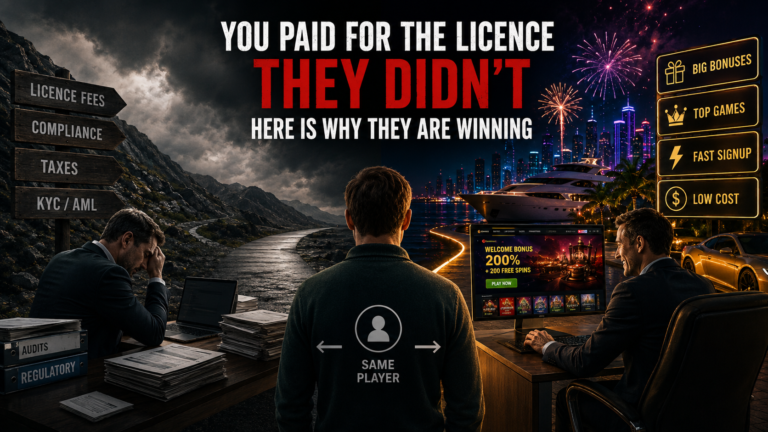
The offshore sites never paid a real, never checked a face and never stopped taking crypto. Brazil’s own licensed-industry body says the ban hands more than 30 million bettors to thousands of illegal sites.
Brazil is not an outlier. It is the loudest example of a pattern now visible on every continent: governments legalise gambling to capture the tax, raise the tax once the market exists, restrict the product when the harm becomes visible, and — increasingly — ban it when the politics turn. At each step the licensed operator pays more, and at each step the unlicensed one gains ground.
This piece looks at where that cycle stands in every major market, why governments keep running it, where the money is going instead, and what signals operators, suppliers and investors should be reading now.
The cycle: legalise, tax, restrict, ban
Most regulated markets now move through the same four stages. They don’t always go in order, and not every market reaches the end, but the direction is consistent — and so is who pays at each step.
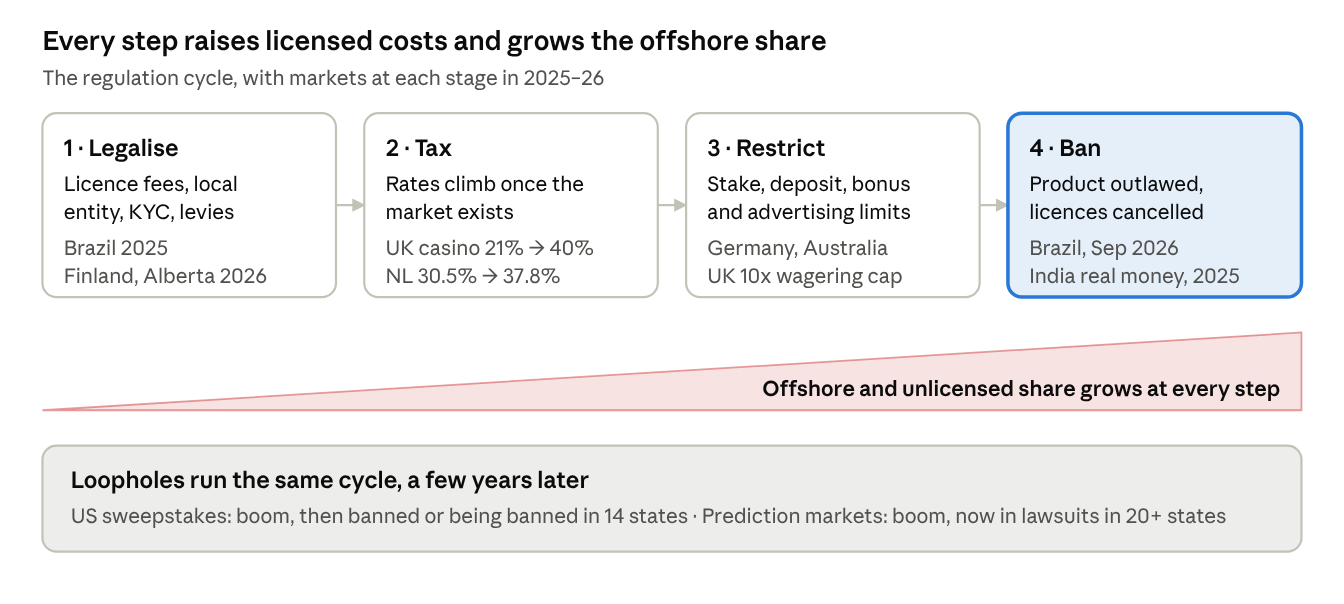
The iGaming People analysis · 4 stages, examples from 2025–26
At stage one, the licence looks like a moat: pay the fee, meet the rules, and the state blocks your unlicensed rivals. By stage two the licence has become a tax base. By stage three it is a list of things you can’t do that offshore competitors still can. At stage four it is worth nothing. Each move lands only on the licensed operator, so the offshore share grows every time the cycle turns.
To see stage two at full volume, look at Britain.
United Kingdom: the tax stage, at full volume
Britain is the world’s reference regulated market, so what happens there gets copied. In 2026 it moved from “regulate” to “extract”.
- Tax: Remote Gaming Duty rose from 21% to 40% on 1 April 2026, the steepest single rise in British gambling tax history. Remote sports betting moves from 15% to 25% in April 2027 (Deloitte).
- Levy: a statutory 1.1% of GGY for online operators since April 2025.
- Product: online slot stakes capped at £5, or £2 for under-25s; bonus wagering capped at 10x and mixed-product promotions banned from January 2026; financial risk checks phased in for heavier spenders (iGaming Times).
The Treasury expects more than £1 billion a year. The Office for Budget Responsibility assumed operators would pass roughly 90% of the cost to players — through lower RTPs, thinner bonuses and fewer free spins (OLBG).
That is exactly the problem. Every one of those levers makes the licensed product worse value than the unlicensed one sitting in the same search results. Smaller brands have already left: GGBET surrendered its UK licences, Lottomatrix and Small Screen Casinos withdrew, and ITV Win closed months after launching (iGaming Expert, Casino Guardian). Flutter projected a $320 million hit to adjusted EBITDA in FY2026, rising to $540 million in FY2027 (HighStakesDB).
Where does the value go? A streaming-traffic analysis suggests unlicensed operators may already be close to 10% of UK online GGR, growing through piracy-linked marketing (iGaming Review). H2 Gambling Capital’s COO put the mechanism plainly to European Gaming: tax and regulation only bind licensed operators, so beyond a point they cannot match unlicensed rivals on odds, bonuses or RTP (European Gaming).
The Dutch warning the UK ignored
The Netherlands ran this experiment first. It lifted its gambling tax from 30.5% to 34.2% in 2025 and to 37.8% in 2026, plus a 1.95% levy. The government expected €108 million of extra revenue in 2025 and €216 million in 2026. It got about €2 million and a projected €57 million (iGaming Business). Licensed online GGR fell about 18.5% in 2025, and while roughly 91% of Dutch players still use only licensed sites, only 53% of the money does (iGaming Times).
That gap is the whole story: the casual player stays; the valuable player leaves. Deposit limits and affordability checks bite hardest on the customers who generate most of the revenue, and those customers have the most reason to go offshore.
Britain is squeezing. Brazil and India skipped straight to the end.
Brazil and India: the ban stage
The UK shows what the tax stage does. Brazil and India show where the cycle ends when politics overtakes economics.
Brazil: 21 months from licence to lockout
Brazil ran the whole cycle faster than any market in history:
- Legalise (Dec 2023–Jan 2025). Law 14,790 created a federal regime; the market opened on 1 January 2025 with R$30m licences, mandatory Brazilian subsidiaries, Pix-only payments and a ban on sign-up bonuses.
- Tax and grow. Licensed operators paid R$9.95 billion in taxes in 2025 and R$8.7 billion in just January–July 2026, up 77% year on year (SBC News). The GGR levy was stepped up from 12% to 13% in 2026, heading for 15% by 2028.
- Advertising rules tightened, banks were ordered to freeze unlicensed operators’ accounts within 24 hours, and about 25,000 illegal sites were blocked by the end of 2025 (iGaming Times).
- Ban (25 Sep 2026). Provisional Measure 1,394 prohibited fixed-odds betting and online casino, presented as a public-health response to household debt. The government cited 10.9 million Brazilians with risky or problem gambling patterns in 2023. A bill that would criminalise operating, advertising and facilitating payments is also drafted (European Gaming).
Note the timing. The ban was signed nine days before the first round of a presidential election in which Lula faces a tight race. Congress has 120 days to approve, amend or let it lapse, and Betano, the ANJL and others are heading to court. But for now the lesson is written: a licence is only as durable as the government that issued it.
And the offshore market was never beaten. A May 2026 Locomotiva survey found 53% of Brazilian bettors had used sites without facial recognition in the previous three months, 37% had deposited by credit card and 23% with crypto — all impossible on a licensed site (Yogonet). The illegal share had only fallen to an estimated 38–44% after 18 months of enforcement. Now it faces no licensed competition at all.
India: skip straight to prohibition
India never had a licensed sports betting market to tax. What it had was a $3.7 billion online gaming industry, most of it real-money and built on the “game of skill” defence: fantasy sports, rummy and poker. In August 2025 Parliament passed the Promotion and Regulation of Online Gaming Act in three days, banning every online money game regardless of skill, and criminalising their promotion. The rules took full effect on 1 May 2026 (Law.asia, A2Z Taxcorp).
Dream11, MPL, Games24x7, Zupee and others shut their real-money products; Dream11 lost the Team India shirt (TechCrunch). The companies that were visible, tax-paying and headquartered in India were the ones that closed. The offshore betting brands that Indian cricket fans already knew — which never paid Indian tax in the first place — lost their biggest domestic competitors overnight. Constitutional challenges are before the Supreme Court.
Brazil and India together removed two of the world’s largest growth markets from the licensed map inside 13 months. For suppliers, affiliates and platform providers who had built 2026 plans around them, that is not a regulatory footnote. It is a hole in the forecast.
America, meanwhile, is running the same cycle — on its loopholes.
United States: one loophole closes, a bigger one opens
America shows the cycle from a different angle. Here the licensed incumbents are strong enough to fight back — and the fight is over who gets to operate without a gaming licence.
Sweepstakes: from grey market to banned in 14 states
Sweepstakes casinos used a decades-old promotional-law principle: offer a free way to enter and it isn’t gambling. That built a multi-billion-dollar industry outside state gaming regulation. Then the licensed industry and the states pushed back. Montana passed the first explicit ban in May 2025; Connecticut followed 146–0 and 36–0, then New Jersey, Nevada, California and New York. In 2026 Indiana, Louisiana, Maine, Tennessee and Oklahoma joined (GamblingSite, Sweeps Kings).
By July 2026 sweepstakes casinos were banned, or facing a dated ban, in 14 states (Oklahoma’s takes effect on 1 November), and California’s AB 831 extended liability to payment processors and affiliates (Lines.com). California alone was roughly 20% of the US sweepstakes business; New York generated $762 million in sweepstakes sales in 2024 (Sweepsy). Florida’s attorney general sued Stake.us and Kick in August 2026, alleging the streaming platform works as a continuous advert for the casino (Forbes).
The sweepstakes model ran the cycle in reverse: no licence, rapid growth, political visibility, then bans. It took about three years.
Prediction markets: sports betting by another name, at federal scale
While states shut sweepstakes down, a much bigger unlicensed product arrived. Prediction markets such as Kalshi are regulated by the Commodity Futures Trading Commission as exchanges, not by state gaming boards — so they offer sports contracts in states where sportsbooks are illegal, without state licences or state gaming taxes.
The numbers are enormous:
- Roughly 87% of Kalshi’s $39.7 billion traded in the year to February 2026 was on sports (Congressional Research Service).
- Combined monthly volume on Kalshi and Polymarket quadrupled from under $5 billion in September 2025 to $24 billion in April 2026, according to Pew (ESPN).
- Prediction markets traded $51 billion in 2025; Bernstein estimates $240 billion by the end of 2026 and $1 trillion by 2030 (DLA Piper).
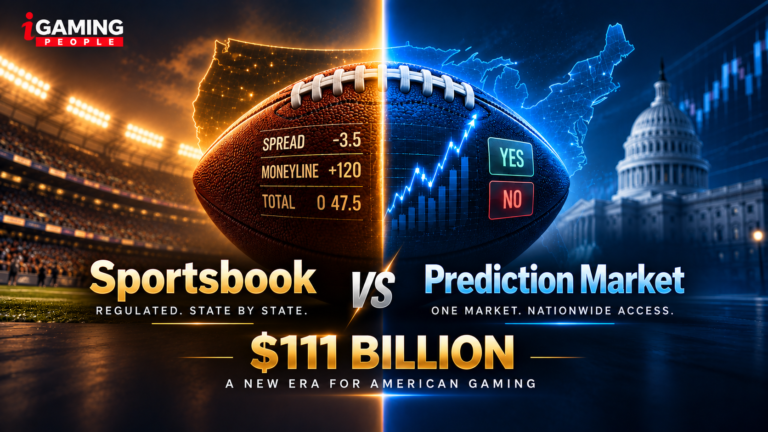
The licensed incumbents did the rational thing: they joined. DraftKings launched Predictions in December 2025; FanDuel partnered with CME Group for FanDuel Predicts; Sporttrade closed its state-licensed sportsbook entirely to become a CFTC exchange (TradingView/Finance Magnates). Our earlier piece on the $111 billion sidestep covers that shift in depth.
How long can it last?
This is where the cycle is already turning. Prediction markets are tangled in lawsuits in at least 20 states; New York’s attorney general is seeking $36 billion in penalties from Kalshi; Arizona filed criminal charges against it in March 2026 (Sludge, Norton Rose Fulbright). Courts are split: the Third Circuit sided with Kalshi against New Jersey, while a federal judge in New York ruled the opposite way, making a Supreme Court showdown likely (RotoWire). Washington became the fourth state to block Kalshi markets in August, and the Financial Times reported that JPMorgan had cut Polymarket off from financial services in October 2025 (CNBC).
The CFTC is fighting for the industry — it has sued at least nine states — but it has also proposed a 267-page rulebook that would bar some sports contracts, such as those on injuries and officiating. Prediction markets today are where sweepstakes were in 2024: huge, growing and legally exposed. The difference is that they have a federal regulator on their side and some of Wall Street’s biggest names on their cap tables. That makes them harder to ban, but it does not make them permanent.
Step back from the headline markets and the picture barely changes.
The wider map: almost every arrow points the same way
Outside the headline markets, the pattern repeats with local variations. Very few markets are loosening; most are adding tax, product limits or advertising bans.
| Market | What changed in 2025–26 | Stage of the cycle | Where the value is leaking |
| Netherlands | Tax 30.5% → 37.8% plus 1.95% levy; untargeted ads banned, sports sponsorship banned from Jul 2025; near-total ad ban and overarching deposit limit planned | Restrict, heading to heavier restrict | Only 53% of spend channelled; licensed online GGR down ~18.5% in 2025 |
| Germany | €1 slot stake cap, €1,000 monthly deposit cap, 5-second spins | Restrict | Regulator puts channelisation at 77%; industry says far lower |
| Australia | Reform Bill passed 19 Aug 2026: no ads during live sport, in venues or on kits; inducement bans; opt-out register; online keno banned; from 1 Jan 2027 | Restrict | Industry warns curtailed promotions push customers to offshore sites |
| Kenya | Gambling Control Act 2025; 5% deposit and 5% withdrawal excise; 15% excise on ad spend; influencer endorsements and inducements banned | Tax + restrict | Offshore apps and crash games compete without the same levies |
| Nigeria | Licensing moved to states; flat 11% GGR contribution and ₦100m licence per vertical; Lagos 5% withholding on winnings | Tax | Multi-state licensing costs vs. operators with one offshore licence |
| Southern Europe | Greece ~35%, Romania ~30%, Italy ~27.5–28.5% effective GGR tax | Tax | Research, some of it industry-commissioned, links GGR tax above ~20% to weaker channelisation |
| Malta | Casino gaming tax rises to 15% on 1 Oct 2026 | Tax (even the hub) | Pressure on the B2C licence many operators use as their base |
| Finland | Monopoly ending; 75 licence applications received | Legalise | The rare market still opening |
The exceptions prove the rule. Finland is opening, and Alberta opened its regulated iGaming market on 13 July 2026. But even these are opening into the new norm: high tax, heavy duty of care, tight marketing. No government is legalising gambling today on the light-touch terms that built the industry’s current giants.
How big is the offshore market really?
Estimates vary enormously, and honesty matters here. H2 Gambling Capital puts the unregulated offshore market at about €20 billion in 2026, up from €12 billion in 2021 and heading for €26 billion by 2031 (European Gaming). A September 2026 Gaming Compliance International report claims unlicensed operators take €91.6 billion, or 72% of EU online gambling money — a figure built from traffic modelling rather than operator accounts, so best read as an upper bound (Business of iGaming, Forbes). A 2026 academic review also warns that industry-funded channelisation studies tend to overstate offshore activity.
The exact size is disputed. The direction is not. Every serious estimate shows the offshore share growing, and the most striking statistic in the GCI report may be the structural one: the average EU multi-product licence costs about €1.1 million up front with roughly 24% tax on revenue, while the four “transnational” licensing hubs it names average about €33,000 and 2.3%.
Which raises the question every operator is asking: why would a government do this to a market it built?
Why governments keep doing this
If higher taxes and bans push players offshore, why do governments keep choosing them? Because from inside a finance ministry or an election campaign, the cycle is perfectly rational. Five forces drive it.
- Licensed operators are the only ones a government can reach. A licensed operator has a local company, a bank account, a tax number and a board of directors. An offshore site has a Curaçao or Anjouan licence and a mirror domain. When a government wants money or wants to be seen acting, it can only squeeze the one it can find. H2’s point applies to every lever: tax, stake limits and ad bans bind only licensed operators.
- Gambling tax is politically cheap. Nobody campaigns to protect betting companies. The UK’s duty rise was preceded by more than 100 Labour MPs urging higher betting taxes to fund the removal of the two-child benefit cap (Kennedys). Illinois pushed its sportsbook tax bills through both chambers late on a Saturday night, without warning, to balance a budget (Nelson Mullins).
- Regulation makes harm visible — and visibility creates backlash. Before licensing, gambling harm is spread across unregulated sites nobody measures. After licensing, there are official dashboards, sponsorship logos on every football shirt and a regulator publishing problem-gambling figures. Brazil’s government cited 10.9 million people with risky gambling patterns; in the US, the share of bettors who say they have “chased” a loss rose from 52% to 60% in a year, and 22% of Americans now know someone with an online betting problem (Siena Research Institute). Regulation succeeds in exposing the problem, then gets blamed for it.
- Households are stretched. Brazil packaged its ban with a plan to renegotiate up to R$150 billion of household debt. When families are indebted, betting becomes an easy symbol of what went wrong, whatever the actual causal share.
- Incumbents lobby against new models. Not every restriction comes from anti-gambling politics. US sweepstakes bans were pushed hard by licensed operators and tribes defending their markets; Connecticut and New Jersey used their own iGaming frameworks to justify the bans (Sweepslots). The same coalition is now fighting prediction markets. Regulation is also a competitive weapon.
Put together, the logic is simple: the licensed industry is visible, taxable, unpopular and politically undefended. The offshore industry is invisible and untaxable. Every policy lever falls on the first group, so the gap between them widens every time a government acts.
While governments squeeze the licensed side, capital is voting with its feet.
Where the money is going instead
While licensed operators absorb taxes and bans, capital is flowing to the two models that sit outside the cycle: offshore operators with light-touch licences, and prediction markets with a federal regulator instead of a gaming one.
Prediction markets: priced like exchanges, not bookmakers
The most striking signal of 2026 is where institutional money has chosen to go. Intercontinental Exchange, the owner of the New York Stock Exchange, committed up to $2 billion to Polymarket, completing it with a $600 million investment in March (company.gi). Kalshi’s $1 billion round at a $22 billion valuation — reported in March and closed as a Series F in May — was led by Coatue with Sequoia, Andreessen Horowitz, Morgan Stanley and ARK Invest; by June it was reportedly seeking money at about $40 billion (Investing.com, CoinDesk).
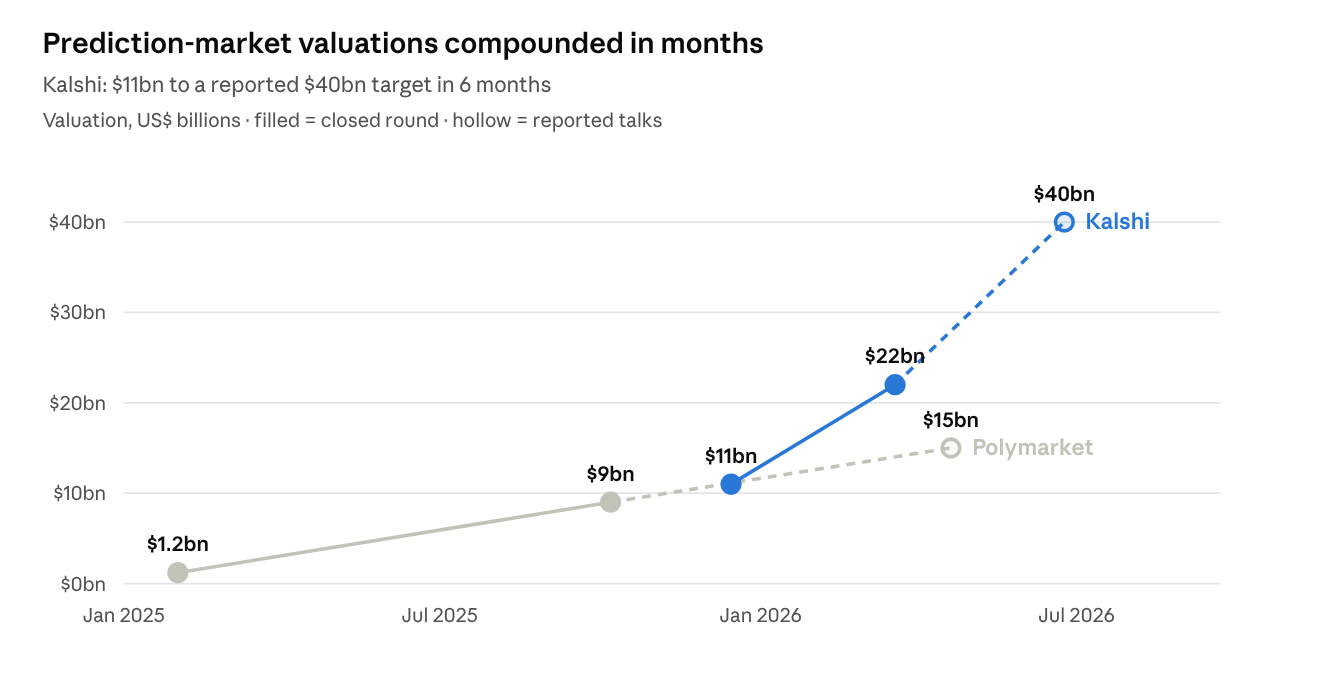
Reported valuations: CoinDesk, Yahoo Finance, TechCrunch, DeFi Rate (2025–26); hollow points are reported talks, not closed rounds
For context, DraftKings — a licensed operator with $6.5–6.9 billion of guided 2026 revenue — saw Q2 2026 adjusted EBITDA fall 62%, partly on promotional spending for its own Predictions launch. Investors are paying exchange multiples for a product that, by volume, is mostly sports betting, precisely because it is regulated as a financial market rather than as gambling. That valuation gap is the market pricing regulatory arbitrage. It is also the market pricing risk: every one of those rounds closed while state lawsuits were live.
Offshore operators: the quiet winners
Offshore brands don’t publish investor decks, but the signals are visible:
- Cheaper licences, lighter tax. The average EU multi-product licence costs about €1.1 million up front with ~24% revenue tax; the four transnational hubs named by GCI average about €33,000 and 2.3% (Forbes).
- Owned attention. During peak World Cup periods, 19% of outgoing traffic from the streaming platform Kick went to Stake, per Similarweb data cited by GCI (Business of iGaming). Licensed operators pay affiliates per player; the largest offshore brand effectively owns a media channel.
- Product freedom. Crypto payments, higher stakes, no deposit caps, no affordability checks and bigger bonuses. In the Netherlands, the KSA itself attributes the fall in channelised spend to high-value players leaving to avoid deposit limits (iGaming Business).
This is not a recommendation to go offshore. The risks are real and rising: Brazil’s draft bill would jail people for operating, advertising or processing payments; Australia’s reforms oblige banks to block illegal operators; California’s sweepstakes law reaches payment processors and affiliates. The enforcement net is widening to the suppliers, payment firms and marketers around offshore brands. But pretending the offshore economy is shrinking is no longer credible, and our earlier analysis of why unlicensed operators are winning still holds.
So which market is next? The warning signs are remarkably consistent.
The signals to read: which market could be next?
Bans rarely come from nowhere. Looking back at Brazil, India, the Netherlands and US sweepstakes, the same warning signs appeared 6–18 months before each hard turn. Operators, suppliers and investors should be scoring every market they depend on against them.
The seven warning signs
- Head of government uses the language of disease or crisis. Lula said betting was “like a cancer” as he signed the ban; Indian ministers framed money games as a social and security threat.
- An election is within 12 months and gambling is a campaign theme.
- Household debt or a cost-of-living story is linked to betting in official statements.
- Tax rises that miss their revenue targets — a sign the next lever will be restriction, not more tax (the Dutch pattern).
- Sponsorship saturation: betting logos on most top-flight shirts or broadcasts. Brazil had betting sponsors on 14 of 20 top-flight clubs (Folkfox).
- Official problem-gambling numbers rising year on year and cited by ministers.
- Payment-system enforcement — banks told to block or freeze gambling flows. Once the rails are built for offshore enforcement, they can be pointed at anyone.
How the major markets score today (our assessment, September 2026)
| Market | Warning signs visible | Most likely next move | Risk to licensed operators |
| Brazil | All seven | Congress confirms, amends or lets MP 1,394 lapse within 120 days | Extreme |
| Netherlands | 3, 4, 6 | Near-total ad ban and overarching deposit limit (draft bill expected 2027) | High |
| UK | 2 (spending pressure), 4, 6 | Further tax or affordability measures in the next Budget cycle | High |
| Australia | 1, 5, 6 | Implementation from Jan 2027; pressure for a full ad ban continues | Medium–high |
| US sports betting states | 4, 6 | More per-wager and higher-rate taxes; promo deductions cut | Medium |
| US prediction markets | 6, 7 | Supreme Court preemption case; CFTC contract limits | High, but binary |
| Kenya | 3, 5, 6 | Wider tax base; further ad limits | Medium |
| Nigeria | 4 (state fragmentation) | More state-level levies and withholding | Medium |
| Germany | 6 | Possible loosening of stake/deposit caps if channelisation keeps falling | Medium, could improve |
Two readings matter most. First, a market can move from “tax” to “ban” in one step if the politics align — Brazil skipped the long restriction phase. Second, the loopholes are on the same cycle, only later. Sweepstakes went from boom to 14-state ban in about three years. Prediction markets are now where sweepstakes were in 2024: big enough to be a political target, not yet settled enough to be safe.
What to do about it
The cycle is not going away. The question is how to build a business that survives it.
Operators
- Price regulatory risk into every market plan. Give each market a probability of a tax jump or ban within 24 months, and only fund acquisition that pays back inside that window.
- Diversify by regime, not just by geography. A book spread across five high-tax, high-restriction markets is one political mood swing from trouble. Mix mature regulated markets, opening markets such as Finland, and products regulated under different frameworks.
- Compete where offshore can’t. Brand trust, fast verified withdrawals, local payment rails, customer service in the local language and sponsorship legitimacy are things a Curaçao-licensed brand cannot easily copy. Bonuses and RTP are the fights you will lose.
- Make the channelisation case with data. The Dutch figures moved the debate because they came from the regulator. Operators that share clean data on player migration have more credibility than trade bodies that only warn.
- Keep a wind-down plan. Brazil gave operators 10 days to pull advertising and 11 days to take sites offline. Have the playbook ready before you need it.
Suppliers and platform providers
- Know your concentration. Evolution had about 9% of sales exposed to Brazil. Know your equivalent number for every market, and cap it.
- Audit your customers’ licences. Enforcement is moving to the ecosystem: California’s law reaches processors and affiliates, Brazil’s draft bill targets payment facilitation, Australia’s reforms bind banks. B2B suppliers serving grey-market brands are next in line.
- Build for both worlds. Prediction markets need pricing, risk, data and integrity tools. That is the same capability set as a sportsbook, sold to a faster-growing customer.
Affiliates
- Don’t build on a single jurisdiction. Better Collective’s 2025 revenue fell 9.4%, with Brazil’s regulation a major factor; Brazil’s ban now removes the market altogether.
- Watch the liability line. Promoting unlicensed operators is increasingly a legal risk, not just a reputational one.
- Follow the new verticals carefully. Prediction markets are already driving affiliate CPA growth in North America, but they carry the legal uncertainty described above.
Investors
- Discount licences. A licence is a political asset, not a permanent one. Model the downside of a ban explicitly.
- Separate regulatory arbitrage from product advantage. Prediction-market valuations price both. Only one of them survives a Supreme Court loss.
The bottom line
For two decades the industry’s promise to governments was simple: regulate us, tax us, and we will move players out of the black market. In 2026 governments cashed the tax cheque and then, in market after market, decided the product itself was the problem.
That leaves the licensed industry in an uncomfortable position. It is the only part of gambling a government can see, tax and punish, and it is being punished for harm that the unlicensed market causes too. Meanwhile the capital that used to flow into licences is flowing into offshore brands and prediction exchanges that sit just outside the rulebook.
That will not last forever. Loopholes get closed; offshore enforcement is moving to banks, processors and affiliates. But the operators who survive the next five years will be the ones who treat regulatory risk as a core business variable, not a compliance department’s problem — and who give players a reason to stay licensed that no offshore bonus can match.
Sources
- What Brazil’s online betting ban means for European operators — European Gaming, 28 Sep 2026
- Brazilian betting yields £1.2bn in 2026 taxes — SBC News
- Brazil gambling licence and regulation 2026 — iGaming Times
- Brazil’s illegal betting share, H1 2026 — Yogonet
- Brazil bets ban: moves for operators and clubs — Folkfox
- UK gambling duties, Autumn Budget 2025 — Deloitte
- Raising the stakes on gambling duty — Kennedys
- United Kingdom gambling licence and regulation 2026 — iGaming Times
- UK casino tax doubles to 40% — OLBG
- Shifts redefining the UK gambling landscape — HighStakesDB
- GGBET exits UK — iGaming Expert
- UK online gaming after the RGD rise — Casino Guardian
- Illegal streams and black-market betting — iGaming Review
- iGaming trends 2026 (H2 Gambling Capital data) — European Gaming
- Dutch gambling tax rise yields far less revenue than forecast — iGaming Business
- Netherlands faces €200m gambling tax black hole — iGaming Business
- Netherlands gambling licence and regulation 2026 — iGaming Times
- Europe’s iGaming market and over-regulation — CCN
- Southern Europe: more enforcement, same problem — Gaming Eminence
- Australia gambling reform — SBC News
- Kenya gambling licence and regulation 2026 — iGaming Times
- Nigeria regulatory guide — Mondaq
- India’s new gaming law bans real-money play — Law.asia
- India online gaming rules from 1 May 2026 — A2Z Taxcorp
- Dream Sports, MPL start pulling the plug — TechCrunch
- Sweepstakes casinos state-by-state — GamblingSite, com, Sweeps Kings, Sweepsy, Sweepslots
- Prediction Markets: Policy Issues for Congress — CRS
- CFTC proposes prediction market rules — ESPN
- Tracking prediction markets and sports betting — DLA Piper
- Prediction markets at a crossroads — Norton Rose Fulbright
- Prediction markets legal timeline — RotoWire
- Prediction markets scrutiny mounts — CNBC
- CFTC suing states for Kalshi and Polymarket — Sludge
- Sporttrade exits sports betting — TradingView/Finance Magnates
- Kalshi targets $40bn valuation — CoinDesk, com
- Prediction markets institutional land grab — company.gi
- Polymarket eyes $15bn valuation — DeFi Rate
- Unlicensed operators take 72% of Europe’s online gambling money — Forbes
- Europe’s unregulated gambling market — Business of iGaming
- Illinois per-bet excise tax — Nelson Mullins
- American Sport Fanship Survey 2026 — Siena Research Institute
- Brazil gives bettors until 5 October (Lula’s “cancer” remarks) — The Rio Times
- Better Collective Q2 2026 (prediction markets driving North American CPA) — iGaming Future
- Alberta’s iGaming strategy — Government of Alberta
- Malta’s casino gaming tax rises to 15% — European Gaming
The market risk scorecard is The iGaming People’s own assessment as of 29 September 2026, not a forecast from any source listed.