
Every year, hundreds of entrepreneurs, investors, and gaming professionals ask the same question: “Which iGaming license should I get?” Most of the answers they find online are generic, outdated, or written by someone trying to sell them a license. This article is none of those things. It is a deep, honest, jurisdiction-by-jurisdiction guide — written for operators, investors, legal professionals, and anyone serious about understanding how the global iGaming licensing landscape actually works in 2026.
Why a License Is Not Just a Formality
Before diving into jurisdictions, let us be absolutely clear about something that many newcomers underestimate: your license choice is not a bureaucratic checkbox. It is one of the most consequential strategic decisions your iGaming business will ever make.
Your license determines:
- Which markets you can legally serve — and which ones are closed to you
- Which payment processors will work with you — EU processors increasingly block unlicensed or Curacao-only operators
- Which game suppliers will supply you — tier-1 studios like Evolution Gaming and Pragmatic Play require credible licensing
- How much players will trust you — a Malta license signals safety; an unknown offshore license signals risk
- What your business is worth — regulated businesses command significantly higher valuations in M&A
- Whether you stay out of legal trouble — operating without the right license in a regulated market is a criminal offence in many jurisdictions
The global iGaming licensing cost spectrum runs from as little as €7,000 for an offshore license to over €500,000 for a premium regulated market license. But as we will show, the true cost is always far higher than the headline fee — and the true value of a good license is worth every cent.
The Licensing Landscape — How to Think About It
Think of iGaming licenses in three tiers:
Tier 1 — Premium Regulated Licenses Maximum credibility, maximum cost, maximum market access. Examples: UKGC (UK), MGA (Malta), Gibraltar
Tier 2 — Mid-Range International Licenses Good international recognition, moderate cost, broad but not universal market access. Examples: Curacao, Isle of Man, Kahnawake
Tier 3 — Budget Offshore Licenses Low cost, fast setup, limited credibility with banks and processors. Examples: Anjouan, Nevis, Costa Rica
Most successful global operators do not choose one tier — they use a combination, strategically layered across their target markets.
The Big Five — In-Depth Profile of Each Major License
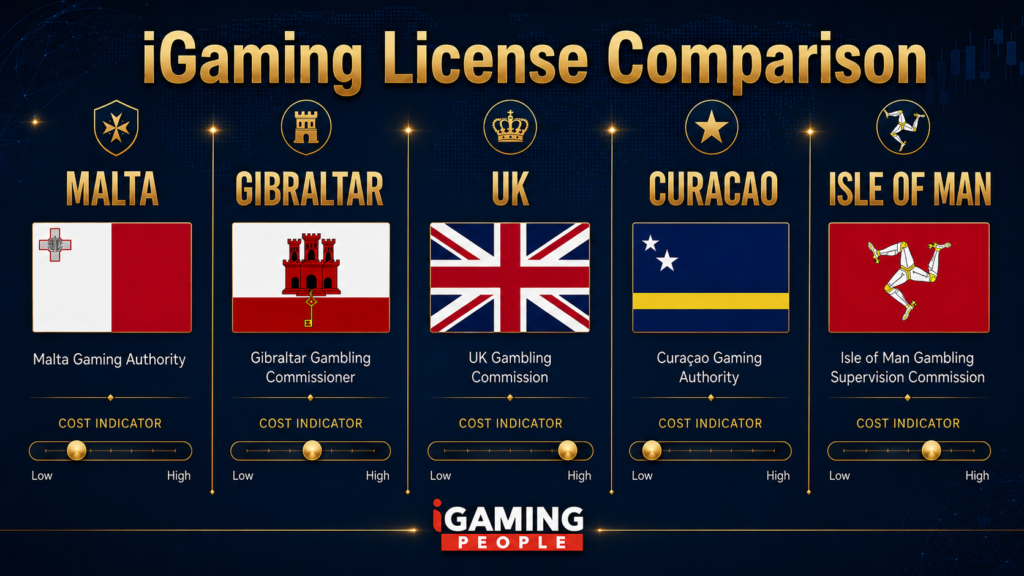
1. Malta Gaming Authority (MGA) — The Gold Standard
The Reputation
If there is one license that commands universal respect in the global iGaming industry, it is the Malta Gaming Authority license. Malta has been a regulated iGaming jurisdiction since 2001 — making it one of the oldest and most developed licensing regimes in the world. Being an EU member state, Malta’s regulatory framework aligns with European law, which gives MGA-licensed operators privileged access to the European market.
What It Costs — The Real Number
Most articles quote the MGA application fee of €5,000. That is dangerously misleading. The true Year 1 cost of an MGA license is substantially higher:
| Cost Component | Amount |
|---|---|
| Application fee | €5,000 |
| Governance impost (annual) | €600,000 (B2C operators) |
| Paid-up capital requirement | €40,000 – €100,000 |
| Legal and compliance setup | €30,000 – €100,000 |
| Local office requirement | €20,000 – €50,000/year |
| Estimated Total Year 1 | €735,000 – €805,000 |
This is not a license for startups with limited capital. This is a license for serious, well-funded operators building for long-term scale.
The Timeline
Plan for 6 to 12 months for a standard application. Poorly prepared applications have been known to take up to 3 years. The MGA scrutinises everything — your software providers, payment flows, responsible gaming protocols, AML/KYC policies, and the backgrounds of every significant shareholder.
What You Get
- EU market access — serve players across the European Union
- Payment processor trust — EU payment processors accept MGA licenses at rates above 85%
- Tier-1 game supplier access — Evolution, Pragmatic Play, NetEnt all work with MGA operators
- Affiliate network access — major affiliates prefer MGA-licensed operators
- Banking relationships — European banks are comfortable with MGA operators
- Credibility that no other offshore license can replicate
Who Should Get It
Established operators with capital, a proven product, and a clear EU market strategy. If you are building to serve European players seriously, there is no substitute.
2. Gibraltar Gambling Commission — The Prestige Alternative
The Reputation
Gibraltar is a British Overseas Territory and one of the original iGaming licensing jurisdictions — Bet365, William Hill, and 888 Holdings all operate under Gibraltar licenses. It carries a reputation for rigour and prestige that rivals Malta’s, with the added advantage of being associated with the British regulatory culture.
What It Costs
| Cost Component | Amount |
|---|---|
| Application fee | €2,000 |
| Annual license fee | €85,000 |
| Capital requirement | €100,000+ |
| Legal and compliance | €50,000 – €150,000 |
| Estimated Total Year 1 | €250,000 – €400,000 |
The Timeline
8 to 12 months. Gibraltar is known for thorough due diligence — the regulatory team is smaller than Malta’s, which means processing times can be longer.
The Unique Feature — Tax Structure
Gibraltar charges a yield-based tax — 1% of gross profit, capped at £425,000 per year. For large operators generating significant revenue, this cap makes Gibraltar one of the most tax-efficient jurisdictions in the world.
Who Should Get It
Large operators who want the prestige of a British-aligned jurisdiction and can benefit from the revenue-based tax cap. Particularly attractive for high-volume sports betting operators.
3. UK Gambling Commission (UKGC) — The Most Demanding License in the World
The Reputation
The UKGC license is the most stringent, most scrutinised, and most respected gambling license on the planet. Operating in the UK without a UKGC license is illegal — full stop. The UK market is worth approximately £14 billion annually, making it one of the most valuable regulated gambling markets in the world.
What It Costs
| Cost Component | Amount |
|---|---|
| Application fee | £3,000 – £10,000 |
| Annual fee | £10,000 – £140,000 (revenue-based) |
| Compliance infrastructure | £100,000 – £500,000 |
| Legal and advisory | £50,000 – £200,000 |
| Estimated Total Year 1 | £200,000 – £800,000+ |
2026 Update — Major Cost Increase
A critical development for 2026: UK remote gaming duty increased from 21% to 40% effective April 2026, with sports betting duty rising from 15% to 25% effective April 2027. For major operators, this represents billions in additional tax burden.
The Compliance Reality
The UKGC does not just license you — it continuously monitors you. Requirements include:
- Stringent AML/KYC checks on all players
- Mandatory affordability checks for high-spending players
- Strict advertising standards — no targeting of vulnerable individuals
- Regular reporting obligations
- Self-exclusion scheme participation (GAMSTOP)
- Responsible gambling tools mandatory for all accounts
Who Should Get It
Any operator seriously targeting UK players. There is no grey area here — either you have a UKGC license or you are breaking the law if you accept UK players.
4. Curacao eGaming — The Global Entry Point
The Reputation
Curacao has long been the world’s most popular iGaming license for operators entering international markets outside of Europe. It is affordable, relatively fast, and internationally recognised in regions where no local regulation exists — particularly Africa, Latin America, and parts of Asia.
However, Curacao’s reputation has faced serious challenges. EU payment processors increasingly block Curacao-only operators. Tier-1 game suppliers are more selective about supplying Curacao licensees. And a major regulatory reform — the LOK (Landsverordening op de kansspelen) framework — is fundamentally changing how the jurisdiction operates in 2026.
The LOK Transition — What Changed in 2026
This is critical information that most guides have not yet caught up with. Curacao’s new licensing framework requires operators to:
- Apply for a new-format license under the LOK regime
- Undergo more rigorous due diligence than the old sub-license model
- Maintain a local Curacao presence
- Demonstrate adequate capitalisation
- Implement proper AML/KYC frameworks
The era of cheap, fast Curacao licenses with minimal oversight is ending. The new Curacao is more expensive and more demanding — but also more credible.
What It Costs — New Framework
| Cost Component | Amount |
|---|---|
| Application fee | $15,000 – $25,000 |
| Annual license fee | $20,000 – $30,000 |
| Compliance setup | $5,000 – $10,000 |
| Estimated Total Year 1 | $40,000 – $65,000 |
Who Should Get It
Operators targeting emerging markets in Africa, Latin America, and Asia where local regulation either does not exist or is not yet mature. Startups building toward a future MGA or UKGC application often start with Curacao to launch quickly and build revenue.
5. Isle of Man — The Quiet Achiever
The Reputation
Less talked about than Malta or Gibraltar, the Isle of Man Gambling Supervision Commission is one of the most technically advanced and professionally run regulators in the world. PokerStars — the world’s largest online poker platform — is licensed in the Isle of Man. That single fact speaks volumes.
What It Costs
| Cost Component | Amount |
|---|---|
| Application fee | £5,000 |
| Annual fee | £10,000 – £50,000 |
| Capital requirement | Variable |
| Estimated Total Year 1 | £50,000 – £150,000 |
The Tax Advantage
The Isle of Man offers a 0% corporate tax rate on most gambling profits — the lowest in any credible jurisdiction. For profitable operators, this is enormously valuable.
Who Should Get It
Established operators who want high-quality regulation with tax efficiency and a technically sophisticated regulatory partner.
How the World’s Biggest Operators Actually Do It — The Multi-License Strategy
Here is the insight that most licensing guides miss entirely: the world’s largest iGaming operators do not hold a single license. They hold a portfolio of licenses, strategically deployed across different markets.
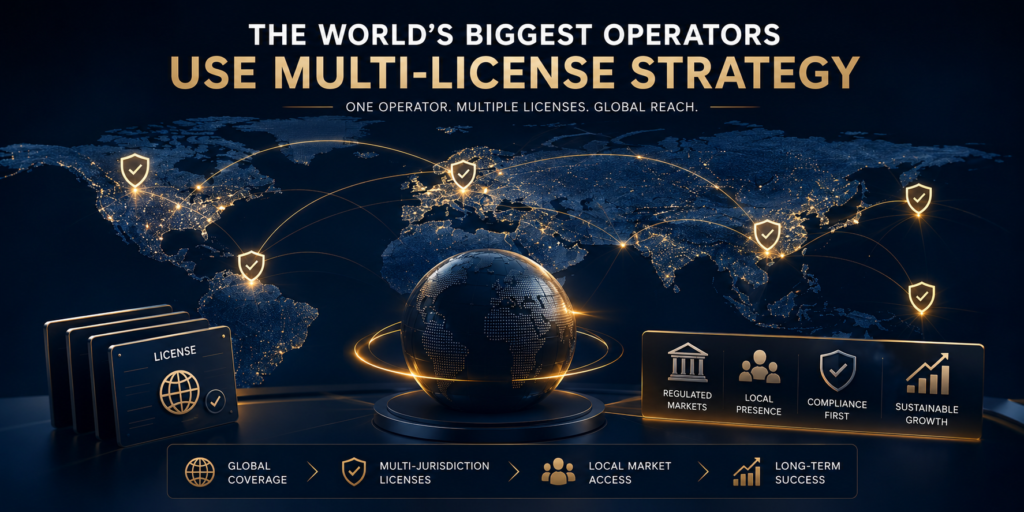
Flutter Entertainment — The Gold Standard of Multi-License Strategy
Flutter Entertainment is the world’s largest online gambling company by revenue — owner of FanDuel (USA), Paddy Power Betfair (UK/Ireland), PokerStars, Sportsbet (Australia), and multiple other brands.
Flutter’s approach is a masterclass in regulatory strategy: a dual-track licensing model consisting of point-of-consumption licenses in regulated markets (UKGC for the UK, state-by-state licenses across the USA, AGCO in Australia) supplemented by multi-jurisdictional point-of-supply licenses from Malta and Gibraltar for international operations.
The result? Flutter operates across more than 100 jurisdictions — each market served by whichever license structure is legally required and commercially optimal. When the UK raised remote gaming duty to 40% in 2026, Flutter had already built the compliance infrastructure to absorb the change faster than smaller rivals. Regulatory complexity, for Flutter, has become a competitive moat — not a burden.
1xBet — The Emerging Markets Multi-License Machine
1xBet, founded in 2007 and headquartered in Cyprus, is one of the most fascinating licensing case studies in global iGaming.
Originally built on a Curacao base license that enabled operations across markets where no local regulation existed, 1xBet has undergone a dramatic strategic pivot in recent years — aggressively acquiring local licenses market by market.
Today, 1xBet holds licenses in over 35 markets globally, with particularly deep penetration across Africa. The operator holds local licenses in Nigeria (National Lottery Regulatory Commission), Kenya, Ghana, Uganda, Cameroon, and the Democratic Republic of Congo — giving it legitimate, local regulatory standing in the world’s fastest-growing iGaming continent.
In early 2026, 1xBet acquired a license to operate in Brazil’s newly regulated market — one of the most strategically significant license acquisitions in recent global iGaming history. The operator’s website is translated into over 40 languages, integrated with 100+ local payment systems, and optimised for low-bandwidth mobile connections — recognising that in African and Asian markets, most users access iGaming via inexpensive Android devices on slow connections.
The 1xBet story is the clearest illustration of a new global licensing philosophy: start with a broad international license, build market presence, then localise with market-specific licenses as regulation matures.
Bet365 — The Quietly Regulated Giant
Bet365 is the world’s largest privately owned online gambling company, processing millions of bets daily across sports, casino, and poker. Founded by Denise Coates in Stoke-on-Trent, UK, Bet365’s licensing strategy is built on regulatory prestige.
The company holds a UKGC license (its home market), a Gibraltar license (for international operations), MGA licenses, and local licenses across its key markets including Australia, Spain, and Italy. Bet365 does not chase emerging markets aggressively — instead, it dominates in regulated markets where its compliance infrastructure provides a competitive advantage.
The lesson: regulatory credibility is itself a product feature. Bet365’s position as a fully regulated operator in its core markets is a key reason millions of players trust it with their money.
The Hidden Costs Nobody Talks About
The license fee is only 15-25% of your total Year 1 licensing cost. Here is what else you need to budget for:
1. Company Incorporation Every jurisdiction requires a locally incorporated entity. Malta requires at least one local company plus a physical office. Budget €5,000 – €20,000.
2. AML/KYC Infrastructure Anti-money laundering and Know Your Customer systems are not optional — they are a condition of every credible license. Proper AML/KYC software and processes cost €20,000 – €100,000 to set up properly.
3. Responsible Gambling Tools Player protection tools — deposit limits, self-exclusion, reality checks — are mandatory under all Tier 1 licenses. Budget €10,000 – €50,000 for proper implementation.
4. RNG Certification Your games must be certified by an approved testing laboratory. Companies like eCOGRA, GLI, and BMM Testlabs charge €5,000 – €30,000 per certification.
5. Legal and Compliance Advisory Do not attempt to navigate a complex licensing application without experienced iGaming lawyers. Budget €30,000 – €150,000 depending on jurisdiction.
6. Ongoing Compliance Licensing is not a one-time event. Annual audits, regulatory reporting, AML monitoring, and compliance staff are ongoing costs that can exceed the license fee itself every year.
The Decision Framework — Which License Is Right for You?
If you are a startup with limited capital targeting emerging markets: Start with Curacao (new LOK framework). It gives you international reach, market validation, and time to build revenue before investing in a premium license.
If you are targeting European players seriously: MGA is non-negotiable for long-term EU operations. Start budgeting for it from day one, even if you launch with Curacao first.
If the UK market is your primary target: UKGC only. No alternative exists legally.
If you are building a global operation: Study the Flutter model. Build a licensing roadmap — start with one or two jurisdictions, expand as revenue grows. Think of licenses as market access investments, not compliance costs.
If you are an existing operator expanding to Africa or LATAM: Start with Curacao for regional reach, then layer in local licenses as markets regulate — following the 1xBet playbook that has proven enormously successful.
2026 — The Year Regulation Got More Serious
Several developments in 2026 are reshaping the global licensing landscape:
Brazil opened for business. The country’s regulated sports betting market officially launched in April 2026, with a 90-day licensing window attracting major global operators. Brazil is the single largest new regulated market to open in years.
Curacao reformed. The LOK framework has fundamentally changed Curacao’s licensing model. The era of minimal-oversight offshore licenses is ending — even in budget jurisdictions.
UK tax increased dramatically. Remote gaming duty doubling to 40% is the largest single tax increase in UK iGaming history, fundamentally altering the economics of operating in the world’s most valuable regulated market.
MGA updated AML requirements. Effective Q2 2026, enhanced AML obligations apply to all MGA licensees — raising the compliance bar and the compliance cost for Malta operators.
The Bottom Line
There is no single right answer to “which license do I need?” — because the right answer depends entirely on your markets, your capital, your timeline, and your long-term ambition.
What is clear is this: the global iGaming licensing landscape is becoming more sophisticated, more demanding, and more expensive every year. The era of cheap, consequence-free offshore licenses is ending. The operators who will win in the next decade are those who treat regulatory compliance not as a burden but as a competitive advantage — just as Flutter Entertainment has done so brilliantly.
Pick your jurisdiction carefully. Budget honestly. Build your compliance infrastructure seriously. And think not just about where you want to be licensed today — but where you need to be licensed in five years.
The license you choose today is the foundation everything else is built on.
The iGaming People covers the global gaming industry with a focus on insight, data, and the people behind the business. Follow us on LinkedIn and Twitter for daily updates from the world of iGaming.
Tags: iGaming License, Malta MGA, UKGC, Gibraltar License, Curacao License, iGaming Regulation, Online Casino License, iGaming Compliance, Flutter Entertainment, 1xBet, Bet365, iGaming Operators
Category: Regulation & Compliance | Industry Analysis
Slug: igaming-license-guide-2026-cost-jurisdiction-compared
Focus Keyword: iGaming license 2026
Meta Description: Complete iGaming license guide 2026 — compare Malta MGA, UKGC, Gibraltar and Curacao from €7,000 to €800,000. Learn how 1xBet, Flutter and Bet365 build their global empires through smart licensing strategy.
Sources & References
- MGA License Costs & Requirements — SB Law, Malta Gambling License Guide 2026 — https://sb-sb.com/services/gambling/gambling-license/malta/
- True Cost of iGaming Licensing — Jurisdiction Breakdown — SourceCodeLab, Real Cost of iGaming Licensing 2026 — https://sourcecodelab.co/real-cost-igaming-licensing/
- Malta vs Curacao vs Gibraltar Comparison — Network42, Gaming License Comparison — https://network-42.com/malta-curacao-gibraltar-license-comparison/
- Top 10 Gambling Licenses 2026 — GGRSoft — https://ggrsoft.com/blog/top-gambling-licenses/
- iGaming License Cost Price Guide 2026 — Global Law Experts — https://globallawexperts.com/how-much-does-an-igaming-license-cost-a-complete-2026-price-guide/
- Flutter Entertainment Dual-Track Licensing Strategy — Gaming Eminence, Operator Intelligence Profile — https://www.gamingeminence.com/post/operator-profile-flutter-entertainment-plc
- 1xBet Licensing Strategy & Regulated Market Pivot — iGaming Business — https://igamingbusiness.com/legal-compliance/where-is-1xbet-licensed-pivot-to-regulated-markets/
- 1xBet Africa & Global Licenses — ChampsBase Review 2026 — https://champsbase.com/en/reviews/1xbet/
- UK Remote Gaming Duty Increase 2026 — Flutter Entertainment Intelligence Profile — https://www.gamingeminence.com/post/operator-profile-flutter-entertainment-plc
- Curacao LOK Reform Framework — Curacao Gaming Control Board — https://www.gamingcontrolcuracao.org/lok-transition
- Brazil Gaming Market Opening April 2026 — iGaming Hub — https://igaminghub.app/events
- MGA AML Updates Q2 2026 — iGaming Hub — https://igaminghub.app/events