




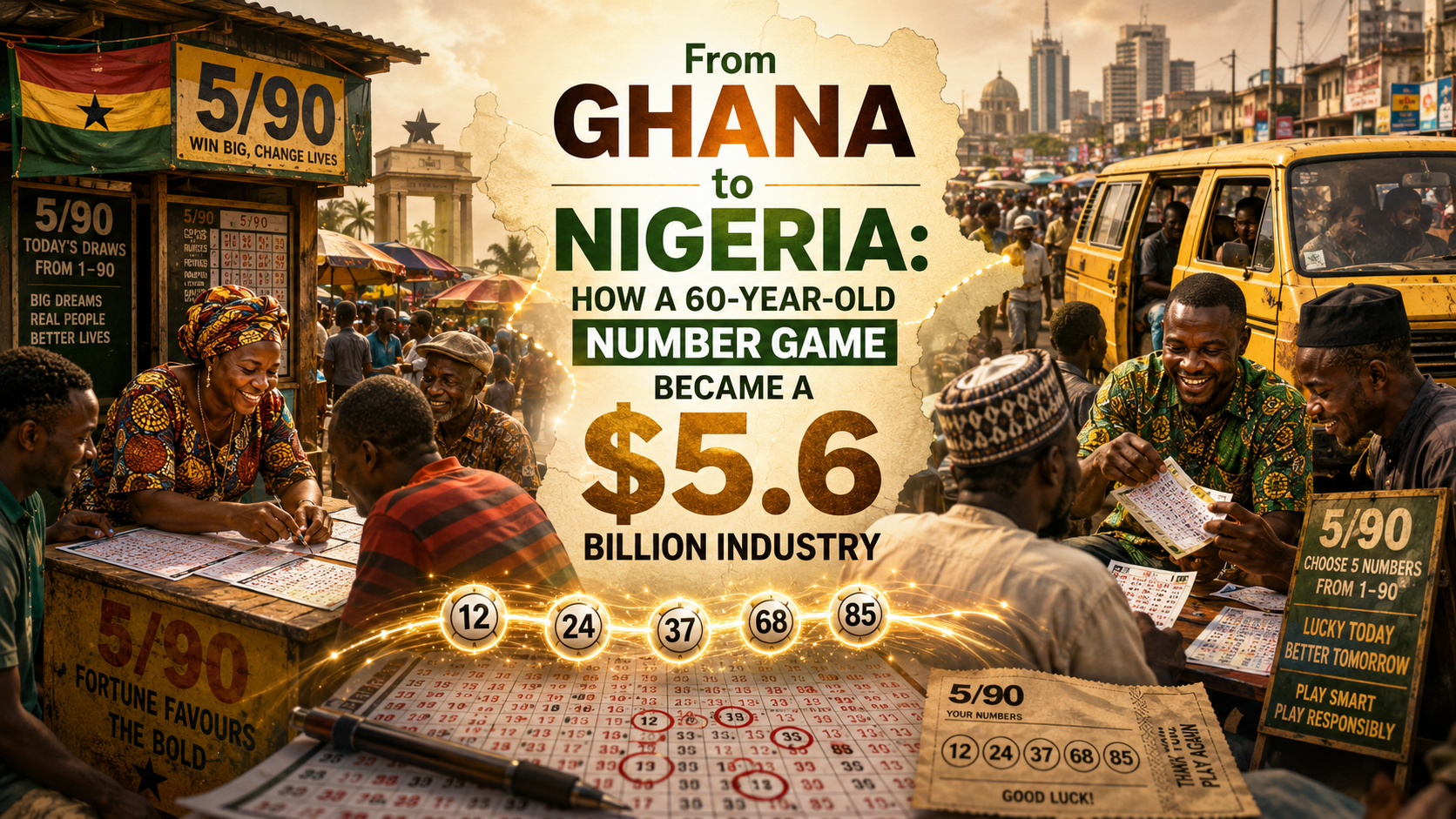
Every morning across Lagos, Accra, Abidjan and Nairobi, before the first cup of tea, before checking WhatsApp, before the school run — millions of Africans are already thinking about five numbers. Which five? That is the question that drives one of the most powerful, most culturally rooted, and most underestimated gaming phenomena on the planet.
What Exactly Is 5/90?
The premise is beautifully simple. Pick five numbers from 1 to 90. If your numbers match the draw — you win. That’s it.
No complicated rules. No confusing side bets. No technology required. Just five numbers, a piece of paper, and hope.
But behind that simplicity lies a $5.6 billion industry — one that is projected to nearly double to $11.32 billion by 2032 — built not just on the mathematics of chance, but on culture, community, dreams, and the very human desire for a better tomorrow.
Where It All Began — Africa’s Lottery Story Starts in Ghana
To understand why 5/90 dominates African lottery revenues, you need to go back to 1958 — the year Ghana became one of the first African nations to gain independence from colonial rule. In that same spirit of nation-building, Ghana established the Department of National Lotteries (DNL) under the National Weekly Lotto Act of 1961.
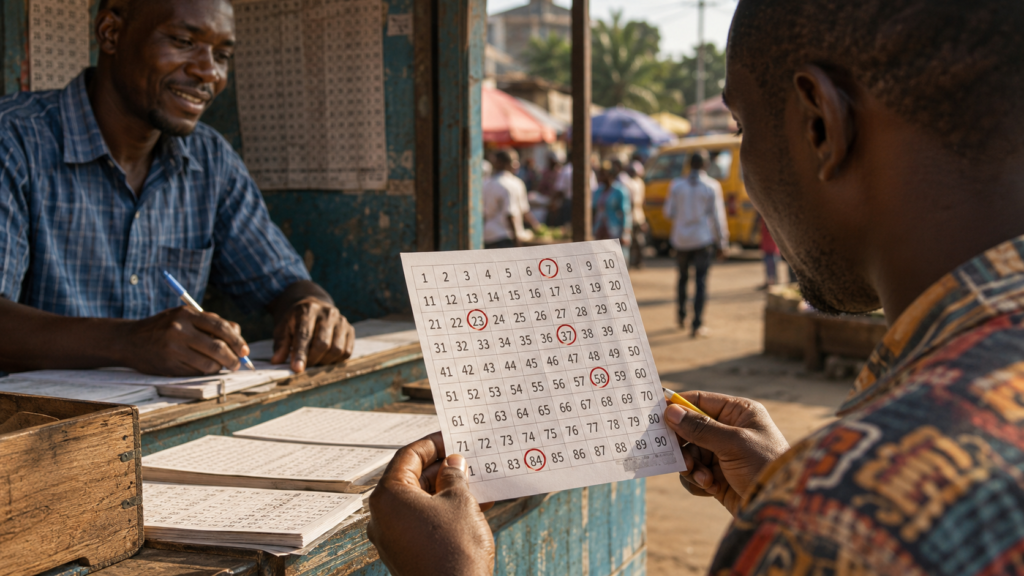
The game’s first Director, Francis William Brennan, introduced the 5/90 fixed-odds format as Ghana’s flagship game. It was practical, it was accessible, and it worked for a population where literacy rates were variable and financial infrastructure was still developing. You did not need a bank account. You did not need a smartphone. You needed a pencil, a ticket, and five numbers.
What happened next was remarkable. The game did not just survive — it became woven into Ghanaian daily life. The National Lottery Authority (NLA) eventually launched seven branded 5/90 products running throughout the week:
- Monday Special
- Lucky Tuesday
- Midweek Wednesday
- Fortune Thursday
- Friday Bonanza
- National Weekly Lotto — the flagship
- Super Lotto
Seven draws. Seven opportunities every single week. That frequency is not accidental — it is genius product design that keeps players engaged without the long wait of weekly lotteries elsewhere in the world.
Today, Ghana’s 5/90 model is so successful that the African Lottery Association (ALA) formally recognises it as the continental benchmark. As Mohammed Abdul Salam, Director-General of the Ghana NLA, stated at the 2026 ALA Board meeting in Accra: “A lot of countries across Africa are emulating the example of Ghana when it comes to the 5/90 lottery.”
Nigeria — Where 5/90 Became a Cultural Phenomenon
If Ghana gave Africa the 5/90 format, Nigeria gave it its soul.
Enter Baba Ijebu — officially known as Premier Lotto Limited, founded in 2001 by Chief Kessington Adebukunola Adebutu. In Nigeria, Baba Ijebu is not merely a lottery. It is a household name, a cultural institution, a daily conversation topic in roadside kiosks, barbershops, and market stalls from Lagos to Kano.
The numbers tell the story: Nigeria’s lottery sector generated ₦1.2 trillion in revenue in 2023 — making it the largest lottery market in Africa by participation.
Baba Ijebu runs two draws per day — 11am and 6pm — meaning a Nigerian player gets 14 chances every single week to change their life. The minimum bet is just ₦50 — less than the price of a sachet of water in Lagos. This accessibility is not a coincidence. It is a deliberate strategy to reach every economic segment of one of the world’s most populous nations.
The Dream Factor — Africa’s Most Unique Lottery Culture
Here is what separates 5/90 in Africa from any lottery anywhere else in the world: the dream interpretation culture.
In Nigeria, Ghana, and across West Africa, players do not simply pick random numbers. They interpret their dreams. A dream about a fish? That maps to specific numbers. A dream about a wedding? More numbers. A dream about death — widely considered lucky in lottery culture — carries its own numerical significance.
Entire books exist dedicated to converting African dream symbols into lottery numbers. WhatsApp groups with thousands of members share nightly dream interpretations. Self-styled lottery prophets — known in Nigeria as “consultants” — run thriving businesses selling number predictions.
This is not superstition in the Western dismissive sense. This is a rich, sophisticated folk epistemology — a belief system where the subconscious mind, ancestral spirits, and mathematical chance intersect in a deeply meaningful way.
Players also follow “number patterns” — tracking which numbers have appeared recently, which are “overdue,” and which combinations feel cosmically right. In behavioural economics, this is known as the “Lottery Illusion” — the deeply human tendency to find patterns in randomness. In Africa’s 5/90 culture, this tendency has been elevated into an art form.
The Economics Behind the Dominance
Why does 5/90 specifically dominate African lottery revenues over other formats? The answer is a combination of five powerful factors:
1. The Odds Are Approachable
In a standard Powerball or EuroMillions, the odds of winning the jackpot are literally one in hundreds of millions. Players know, rationally, they will never win. In 5/90, the prize structure includes multiple tiers — match 2, match 3, match 4, match 5 — meaning smaller wins happen frequently enough to sustain hope and keep players returning.
2. The Price Is Democratic
At ₦50 minimum in Nigeria or a few Ghana Cedis in Ghana, virtually any working adult can participate. This is not an entertainment product for the middle class — it is genuinely accessible to street traders, market women, motorcycle taxi riders, and subsistence farmers.
3. The Frequency Creates Habit
Two draws daily in Nigeria. Seven branded draws weekly in Ghana. This frequency creates habitual participation — morning and evening rituals that structure the day around the lottery in the same way that morning prayers or evening news does in other cultures.
4. The Social Layer Is Powerful
5/90 is rarely a solitary activity. Groups of friends pool money on combinations. Workplace syndicates form. Families discuss numbers at dinner. The game is a social glue — a shared experience that crosses class, education, and generational lines in a way that few other entertainment products do.
5. The Cultural Legitimacy Is Established
Decades of government-operated lotteries have given 5/90 a legitimacy that sports betting — despite its explosive recent growth — still struggles to match in the eyes of older African consumers. The National Lottery Authority is a government body. Playing the national lottery feels less like gambling and more like participation in a national institution.
The Digital Revolution Is Supercharging 5/90
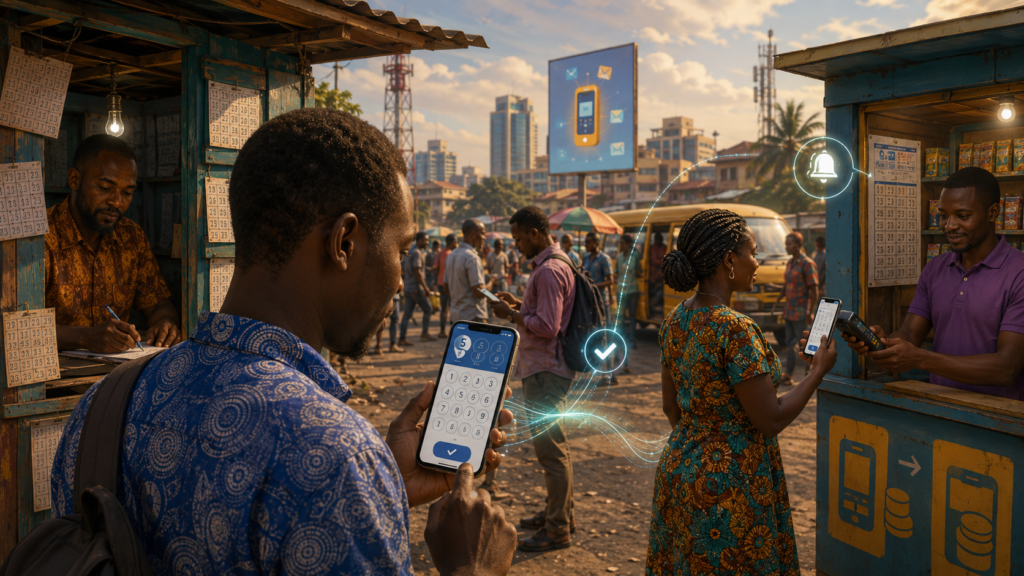
For decades, 5/90 lived entirely in the physical world — paper tickets, kiosk agents, roadside vendors. That world is changing fast, and the numbers are staggering.
In Kenya, mobile money accounts for over 70% of lottery transactions — driven by the country’s extraordinary M-Pesa adoption. The integration of mobile money with lottery platforms has been transformative, allowing rural players to participate without travelling to urban centres.
In Ghana, 590Mobile allows players to participate in NLA draws directly from their smartphones — bringing the national lottery to every corner of the country regardless of physical infrastructure.
The implications for the industry are profound. Digital platforms enable:
- Real-time draw broadcasts — players watch results live on their phones
- Instant payout notifications — no more waiting at the kiosk
- Data analytics — operators understanding player behaviour at scale
- New game variants — faster, more interactive versions of the classic format
- Responsible gambling tools — spend limits, self-exclusion, and player protection
With smartphone penetration accelerating across Sub-Saharan Africa and internet connectivity improving significantly, the 5/90 market is positioned for its most dramatic growth phase yet.
The Social Contract — How 5/90 Funds Africa’s Future
Perhaps the most underappreciated dimension of the 5/90 story is its role as a development finance instrument.
In Ghana, NLA lottery revenues fund education initiatives, healthcare programmes, youth employment schemes, and community development projects. These are not token contributions — they represent millions of cedis annually channelled into the national budget.
The ecosystem also creates employment at every level. Ticket vendors and kiosk operators provide income for tens of thousands of Africans, many in rural areas where formal employment is scarce. Mobile app developers, RNG system technicians, customer service agents, compliance officers — the 5/90 industry has quietly created an entire employment ecosystem across the continent.
This social contract — where players understand that their participation contributes to national development — adds another layer of cultural legitimacy to the game. You are not just buying a chance at a jackpot. You are, in a small way, investing in your community.
The Continental Benchmark — Ghana Leads the Way in 2026
The African Lottery Association’s 2026 Board meeting in Accra sent a clear signal: the 5/90 model, as developed and refined in Ghana over six decades, is the future of African lottery.
Committees are being established within the ALA specifically to share governance protocols, compliance frameworks, and operational best practices — with Ghana’s NLA structure serving as the template.
Director-General Abdul Salam has outlined an ambitious 2026 agenda: governance reforms, new product launches, and a continued push toward digital integration. The ambition is explicit — to build a continental lottery ecosystem where African operators share knowledge, technology, and standards.
This is not a market in decline. This is a market at the beginning of its most exciting chapter.
What This Means for the iGaming Industry
For operators, suppliers, platform providers, and investors watching Africa, the 5/90 story contains several clear lessons:
Simplicity scales. The most complex product is not always the most successful. 5/90’s elegant simplicity has proven more durable than dozens of more sophisticated formats.
Culture is a moat. The dream interpretation culture, the social participation model, the daily ritual — these are not features that a competitor can simply replicate with better technology. Cultural embeddedness takes decades to build.
Frequency drives revenue. Multiple draws per day create habitual engagement in a way that weekly draws simply cannot match. Operators designing products for African markets should think carefully about draw frequency.
Mobile-first is not optional. With M-Pesa-style mobile money adoption accelerating across East and West Africa, lottery operators who are not mobile-native will be left behind.
The market is just getting started. A $5.6 billion market growing to $11.32 billion by 2032 — in a continent where smartphone penetration is still accelerating — represents one of the most significant opportunities in global gaming.
The Bottom Line
Five numbers. One to ninety. Twice a day.
What sounds like the simplest game imaginable has, over six decades, become the financial backbone of African lottery markets, a vehicle for national development, a cultural institution, and a daily ritual for tens of millions of people.
5/90 does not dominate African lottery revenues despite its simplicity. It dominates because of it — because it understood the African player, the African economy, and the African spirit better than any imported format ever could.
That is not a coincidence. That is a masterclass in market fit.
The iGaming People covers the global gaming industry with a focus on insight, data, and the people behind the business. Follow us on LinkedIn and Twitter for daily updates from the world of iGaming.
Tags: African Lottery, 5/90 Lottery, Ghana NLA, Baba Ijebu, Nigeria Lottery, iGaming Africa, Lottery Market, African Gaming Industry
Sources & References
- Africa Lottery Market Size & Forecast ($5.6 billion — $11.32 billion by 2032) — Mark Wide Research, Africa Lottery Market Report 2025-2034 — https://markwideresearch.com/africa-lottery-market/
- Ghana National Lottery Authority — History, Products & Social Impact — Skilrock, History and Evolution of the 5/90 Lottery Game — https://www.skilrock.com/blogs/history-and-evolution-of-the-5by90-lottery-game
- Nigeria Lottery Sector Revenue (₦1.2 trillion, 2023) — Leadership Nigeria, Most Popular Lotteries in Africa — https://leadership.ng/most-popular-lotteries-in-africa/
- Baba Ijebu — Premier Lotto Nigeria — Official Platform — https://babaijebus.com/
- Ghana 5/90 as African Benchmark — ALA Board Meeting 2026 — Focus GN — https://focusgn.com/africa/africas-gambling-industry-looks-to-ghanas-5-90-lottery-to-lead-the-continent-in-2026
- Kenya Mobile Money Lottery Transactions (70%) — Leadership Nigeria, Most Popular Lotteries in Africa — https://leadership.ng/most-popular-lotteries-in-africa/
- 5/90 Digital Transformation in Africa — Digital Gaming Services — https://www.digitalgamingservices.co.za/how-to-conquer-the-5-90-lottery-market-in-africa/